The decommissioned Peugeot P4 from the French army presents a maintenance issue that classic car guides do not cover. Derived from the Mercedes G-Class and inheriting components from the Peugeot 404, this military machine ages according to its own logic: corrosion of closed cavities, transmission to monitor on permanent four-wheel drive, and parts supply that comes from both the Mercedes network and salvage from donor vehicles. Measuring the true critical areas allows for prioritizing interventions.
Decommissioned Peugeot P4: wear points compared to a civilian 4×4
A P4 is not a modern SUV. The components that fail first are not the same, and the costs of restoration vary depending on the supply chain.
| Maintenance Item | Decommissioned P4 | Recent Civilian 4×4 |
|---|---|---|
| Chassis / corrosion | High priority: floors, anchor points, closed cavities exposed to mud and salt | Moderate priority: newer factory anti-corrosion treatments |
| Engine parts supply | Mercedes G network (exchange standard) + salvage from donor P4s | Manufacturer network, new parts available |
| Transmission (gearbox, axles, driveshafts) | Regular checks of gearbox and axle oil levels, boots, seals | Longer intervals, long-lasting lubricants |
| Braking | Systematic checks before each restart after immobilization | Standard maintenance according to mileage |
| Electricity / battery | Simplified circuit but sensitive to prolonged immobilization | Complex electronics but integrated battery management |
This table highlights a major gap: on a P4, corrosion and the transmission concentrate most of the risk, whereas a recent civilian vehicle primarily requires electronic monitoring and mileage-based servicing. A P4 owner who applies a modern car maintenance plan overlooks the real weak points.
To extend the life of your Peugeot P4, one must think in terms of structural preservation as well as routine mechanics.
P4 Chassis Corrosion: The Item No One Monitors Early Enough
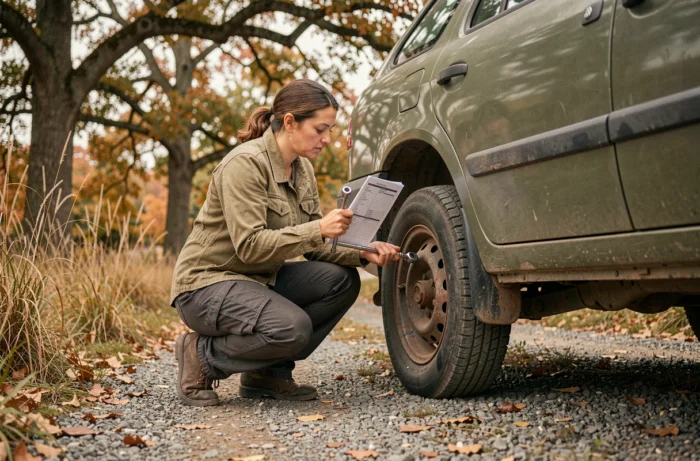
Most decommissioned P4s have spent years in muddy terrains, in conditions where meticulous washing was not a priority. The result: the chassis rails, floors, and anchor points accumulate trapped moisture in closed cavities, sometimes invisible during a quick inspection.
Rust Treatment and Drying After Off-Road Use
A P4 stored without anti-corrosion treatment deteriorates faster when stationary than when driving. Stagnant air in a damp garage accelerates oxidation, especially in areas already weakened by perforating rust.
- After each muddy outing, rinse the underbody with low-pressure water, focusing on wheel arches, chassis rails, and cavities behind the wings
- Apply a wax or grease-based anti-corrosion product to exposed areas at least once a year or after any prolonged contact with saltwater
- Inspect the floors from underneath at each seasonal change: military-grade steel is thick, but once rust sets in deeply, repairs become structural
This preventive work costs little in time and materials. However, replacing a perforated floor or welding a corroded anchor point requires specialized bodywork, rarely available in a general workshop.
P4 Transmission and Axles: Check What the Engine Does Not Reveal
The diesel engine of the P4 is robust and relatively easy to maintain. The complete powertrain, however, requires attention that many owners underestimate.
Transfer case, front and rear axles, driveshafts: each component has its own oil level, seals, and boots. On a military vehicle that has operated under extreme conditions, these elements have often been stressed well beyond what road use imposes.
Checks to Perform Before Any Restart After Immobilization
A P4 that remains stationary for several weeks accumulates invisible risks. The transmission seals dry out, the axle oil settles, and the brake discs can warp due to surface corrosion.
- Visually check the condition of the CV joint boots and transmission seals: a crack allows dust in and condemns the joint in the short term
- Check the oil level of the gearbox and each axle separately, using the viscosity recommended by Mercedes for the same-era G-Class
- Before driving, pump the brake pedal several times to restore pressure, then test at low speed over a few meters
- Never leave the tank nearly empty during prolonged immobilization: condensation in a low-filled tank contaminates the fuel system
Peugeot P4 Spare Parts: Mercedes Supply Chain, Donors, and Exchange Standard
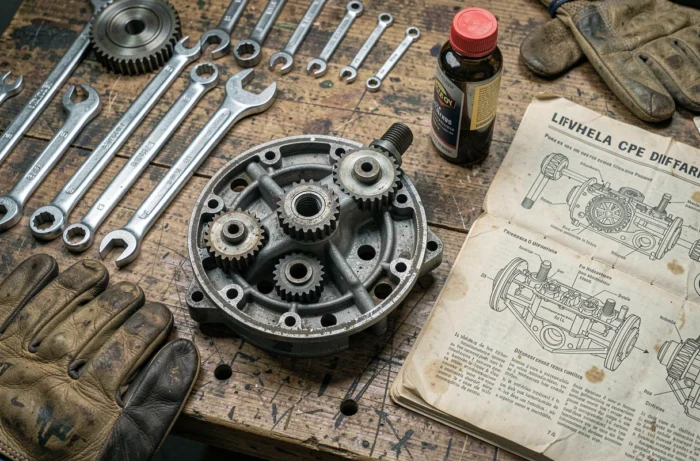
Finding parts for a P4 does not work like for a classic Peugeot. The vehicle shares its mechanical base with the Mercedes G-Class (type 460/461), which opens two distinct supply channels.
The Mercedes network still offers certain parts on an exchange standard, particularly for steering, braking systems, and engine components. Lead times vary, and the prices are those of a premium German vehicle, not a French utility.
Conversely, salvaging from donor P4s remains the most reliable source for parts specific to the French military assembly: winch mounts, specific body elements, dashboard accessories. Specialized forums and military vehicle gatherings constitute the informal network where these parts circulate.
Cross-Compatibility with the Mercedes G-Class
Not all parts from the G-Class fit directly onto the P4. The running gear, steering, and engine block are largely compatible. Body elements, lighting, and some interior equipment differ. Before any order, cross-referencing the Mercedes reference with the P4 part number avoids costly returns.
The longevity of a decommissioned P4 depends less on the displayed mileage than on the rigor applied to the three described areas: protected chassis, monitored transmission, sourced parts in advance. An owner who anticipates these points maintains a reliable military vehicle for many years, whereas a standard automotive maintenance approach overlooks the real warning signals.