
You are going to your in-laws for three days with an eight-month-old baby, a cabin suitcase, and a small car trunk that is already full. The classic travel crib, with its twelve kilos and bulky transport bag, simply won’t fit. This is when the choice of a compact and lightweight travel crib becomes a real technical question, not just an impulse purchase.
Air travel constraints and folded dimensions of the travel crib
Most comparisons focus on the weight of the crib when unfolded. In practice, it’s the bulk when folded that poses a problem while traveling. A model advertised as compact may very well exceed the dimensions allowed for cabin luggage according to airlines, or may not fit into a car trunk that is already loaded.
Before buying, measure the available space in the trunk or suitcase and compare it with the folded dimensions provided by the manufacturer. A difference of a few centimeters between two models can make the difference between a crib that fits and one that stays at home.
To delve deeper into the choice of a compact and lightweight travel crib, it is worth comparing the folded formats of several brands rather than relying solely on the displayed weight.
Another often overlooked point: if you are traveling by plane, the travel crib is generally accepted in the hold as free baby equipment. Feedback varies on this point according to low-cost airlines, which sometimes impose restrictions on the number of allowed items. Check the transport conditions before booking.
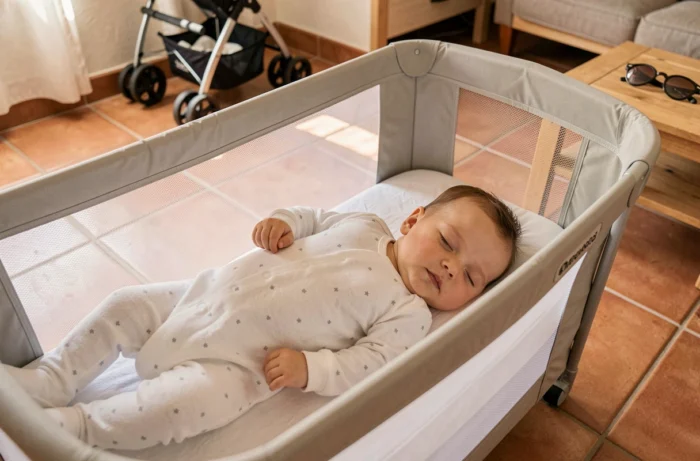
Travel crib mattress: thickness, suffocation risk, and EN 12227 standard
There is a lot of talk about comfort, but rarely about mattress safety. The European requirements related to the EN 12227:2010 standard for travel cribs are not limited to the structure: they also cover suffocation risk prevention related to the mattress.
Specifically, the mattress must provide a flat sleeping surface and not be too thick. An oversized mattress or one added by parents can create a gap between the edge of the crib and the sleeping surface, in which a baby risks getting their face stuck.
What to check before using a folding bed mattress
- The mattress provided with the crib is the only one to use. Adding a separately purchased mattress alters the interior space and compromises product compliance.
- The fasteners (Velcro straps, corner elastics) must keep the mattress pressed against the bottom of the crib. A mattress that moves during the night is a dangerous mattress.
- The surface must remain flat even after several foldings. Some cheap travel crib mattresses deform quickly and create dips.
A properly fitted and dimensioned mattress offers better protection than a thick and poorly adjusted mattress. This is the most underestimated safety point in buying guides.
Actual weight and folding of the folding bed: what the terrain changes
On a product sheet, a “one-handed fold” seems appealing. In reality, you have a tired baby in your arms and a transport bag stuck under the stroller. The ease of folding and unfolding is tested under these conditions, not in a showroom demonstration video.
Two systems coexist. The central folding (the crib folds in on itself in two) gives an elongated but flat format, easy to slide along a suitcase. The accordion folding produces a more cubic format, sometimes more compact but thicker. Neither is objectively superior: the best fold is the one you can master with one hand.
In terms of weight, the difference between a lightweight model and a standard model often represents several kilos. When you are moving between the train station, airport, and taxi, every kilo less on your shoulder counts. The lightest models on the market weigh around five to six kilos, including the structure and transport bag.

Buying a travel crib on a marketplace: compliance pitfalls
With the tightening of security checks on marketplaces, a travel crib sold online is not always accompanied by proof of mechanical and physical testing. The terms “compact” or “lightweight” on a product sheet do not guarantee anything about the actual compliance of the product.
Concrete signals to check on a product sheet
- The explicit mention of the EN 12227 standard (or its exact reference EN 12227:2010) in the technical specifications, not just in the marketing text.
- The presence of the CE marking, which certifies a declaration of European conformity. A product without a CE marking sold in Europe is in violation.
- The clear identification of the responsible manufacturer or importer, with an address in the European Union. A third-party seller without traceable contact information is a warning signal.
This point is particularly sensitive for cross-border purchases or entry-level travel cribs imported. A compliant crib rarely costs the lowest price on the market.
Child’s age and realistic duration of use of the travel crib
A travel crib is generally used from birth (with a compatible booster provided by the manufacturer) until the child reaches the indicated weight or height limit. In practice, most children stop sleeping in it well before this limit, simply because they refuse to stay there.
Opting for a compact model with two sleeping levels allows you to cover the first months (upper level, more accessible for placing and retrieving the infant) and then switch to the lower position when the child starts to sit up. The double level extends the actual duration of use by several months.
A travel crib remains a supplementary bed. You do not replace the crib in the room with a folding model used every night. For extended stays of several weeks, the comfort of a compact travel crib mattress shows its limits, regardless of the brand.