
The concentration of allergens in a formula matters more than its marketing label. A fragrance sold as “natural” may contain linalool, geraniol, or citronellol at levels sufficient to trigger contact eczema, while a well-balanced synthetic composition may go unnoticed on reactive skin. Choosing a fragrance for sensitive skin relies on reading the ingredients, understanding the formulation vehicles, and adhering to a few often-overlooked application rules.
Fragrance allergens and European regulation 2023/1545: what changes for reactive skin
The regulation (EU) 2023/1545 requires, starting July 31, 2026, the declaration of more than 80 fragrance allergens on cosmetic packaging, up from 24 previously. For sensitive skin, this extension transforms reading an INCI list into a truly usable sorting tool.
Specifically, molecules like alpha-isomethyl ionone, coumarin, or certain oak moss extracts, which were previously buried under the generic term “fragrance,” will need to be listed by name as soon as their concentration exceeds the regulatory threshold. We recommend prioritizing compositions with a short INCI list, not out of minimalism, but because a formula with fewer than twenty fragrant components mechanically reduces the likelihood of encountering a personal allergen.
A detailed article addresses the issue of reconciling scented water and sensitive skin on Miss Marion, exploring formulations that limit irritating compounds without sacrificing olfactory richness.
Photosensitization and fragrance: an underestimated risk in summer
Immediate irritation (redness, itching) is not the only danger. Some fragrance molecules are photosensitizing: under UV exposure, they can cause burns, hyperpigmentation, or persistent brown spots. Furocoumarins, found in citrus absolutes (bergamot, lime), are the most documented.
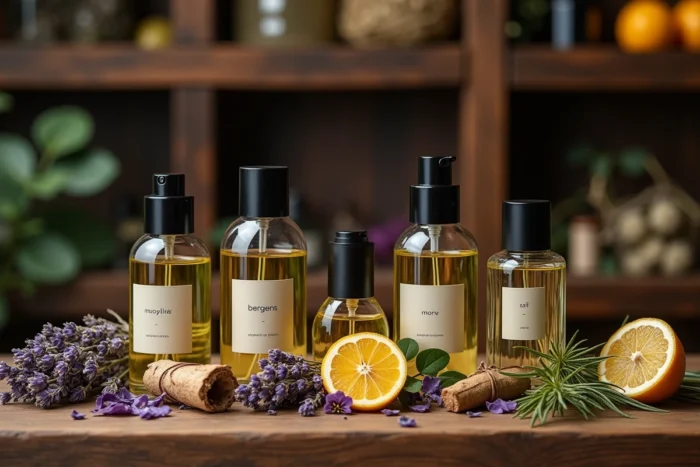
The classic reflex of spraying perfume on the neck or wrists exposes precisely the most irradiated areas. On sensitive skin, the combination of alcohol + allergen + UV creates an inflammatory cocktail that even sunscreen does not completely neutralize, as the perfume is applied under the cream or alters its film.
For the warm months, spraying perfume on clothing or hair eliminates direct contact with the skin. Textile fibers diffuse the scent without causing a skin reaction. Hair mists, formulated without denatured alcohol, provide a credible alternative.
Formulation vehicles: alcohol, oil, and water, three distinct tolerance profiles
The base of the perfume influences both tolerance and the fragrant molecules themselves. Three main families stand out:
- Alcoholic base (ethanol): the predominant vehicle in fine perfumery. Denatured ethanol dries out the stratum corneum and weakens the skin barrier. On atopic or eczematous skin, a burning sensation appears within seconds. The concentration of ethanol varies significantly between a perfume extract (lower alcohol proportion, higher oil concentration) and an eau de toilette (high alcohol proportion, immediate but aggressive projection).
- Oily base (oil perfumes, roll-ons): the lipid support limits abrupt evaporation and buffers the contact between fragrant molecules and the skin. Longevity is often greater on dry skin, and diffusion is more intimate. Jojoba or fractionated coconut oils are inert from an allergenic standpoint.
- Aqueous base (body mists, scented waters): the gentlest, but also the most fleeting. The low concentration of fragrant raw materials reduces the risk of irritation. In return, the longevity rarely exceeds a few hours.
We observe that sensitive skin tolerates oily roll-on formats better than alcoholic sprays, even at equivalent fragrant concentrations. The application gesture (light rubbing versus direct spraying) also plays a role in the skin reaction.
Olfactory families and sensitive skin: which to avoid, which to explore
Not all notes have the same irritating potential. Oriental families rich in resins, synthetic vanillin, and balsams (benzoin, opopanax) concentrate molecules with high sensitizing power. Classic chypres containing oak moss (Evernia prunastri) are among the most at-risk compositions.
Conversely, fresh-green accords and modern synthetic white musks exhibit a significantly higher tolerance profile. Macrocyclic musks, for example, provide a clean and lasting trail without triggering the sensitization mechanisms associated with nitrated or polycyclic musks, which have largely been abandoned by the industry.
Floral notes fall somewhere in between. Linalool (lavender, neroli) and geraniol (rose, palmarosa) are declared allergens, but their irritating potential depends on the dose and purity. A quality linalool, protected from oxidation by suitable packaging, causes far fewer reactions than an oxidized linalool found in a bottle that has been open for several months.
Testing protocol for reactive skin: the steps to follow
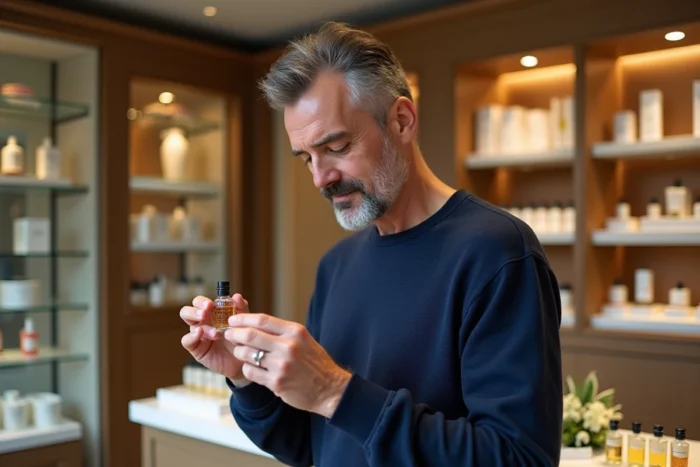
Testing a perfume in-store on the wrist is insufficient for sensitive skin. We recommend a three-step protocol:
- Apply a drop in the elbow crease (a thin and reactive area) and observe for at least 48 hours. A delayed reaction at 24 or 48 hours indicates allergic sensitization, not just mechanical irritation.
- If no reaction appears, test on the final application area (neck, décolletage, wrist) on hydrated skin, never just after a shower, as heat and open pores amplify the penetration of allergens.
- Observe the longevity and comfort over a full day before investing in a bottle. The two-milliliter samples offered by most niche houses are sufficient for this protocol.
The 48-hour delay distinguishes a true evaluation from a superficial cosmetic test. Allergic contact dermatitis manifests between 24 and 72 hours, well after the top notes have faded.
With the expansion of the list of declared allergens expected for 2026, careful reading of the composition will become as common a reflex as checking food ingredients. Choosing a fragrance for sensitive skin does not mean giving up olfactory complexity, but learning to read a formula as one reads a map.