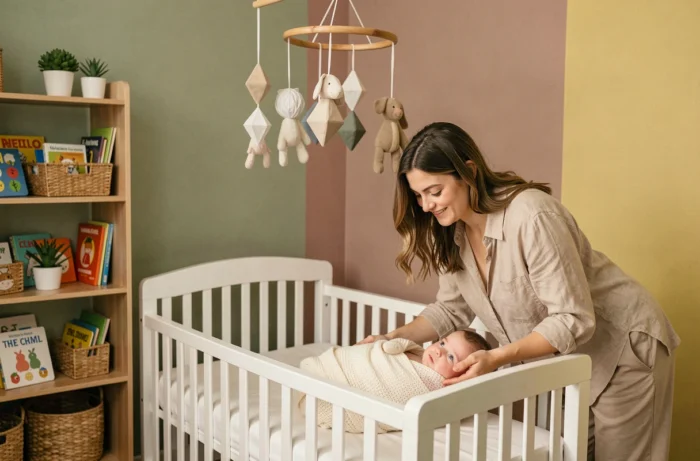
An infant does not perceive colors like an adult. During the first weeks, their retina primarily distinguishes strong contrasts, and then their visual palette gradually expands over several months. Creating a colorful environment for a baby’s awakening therefore requires following this maturation rather than choosing shades based on a decorative whim.
Visual Maturation of the Infant and Choice of Contrasts
Recent Montessori educational resources, particularly those published by Pass Montessori, remind us of a fact often overlooked in decoration guides: before three months, black and white take precedence over any other color. The baby’s visual system is not yet capable of distinguishing chromatic nuances. Mobiles or black and white cards, presented at a short distance and in brief touches, correspond to this stage of development.
After three to four months, bright colors can be gradually introduced. Saturating the environment with varied shades from birth does not provide useful stimulation, as the infant’s eye simply does not capture them.
Specialized catalogs like https://bebecolor.com/ offer accessories and linens designed to accompany this progression, combining contrasts and colors suitable for each age group.
Contrasting cards should also not be omnipresent. Pass Montessori emphasizes alternating between moments of visual stimulation and sober visual moments to avoid sensory overstimulation of the infant. A wall completely covered with graphic patterns produces the opposite effect of what is intended.
Light and Screens in Baby’s Awakening Space
Color does not come solely from objects and walls. Lighting alters the perception of shades and influences the infant’s circadian rhythm. On this point, available data converge towards a clear caution regarding blue light.
Blue Light and Melatonin Production
Several publications from 2026, including those reported by Mothair and TinyPal, confirm that the blue light emitted by screens disrupts melatonin secretion in young children.
For a nightlight, red-orange or amber tones are preferable. Cold white or bluish lighting in the awakening space, even indirect, can delay falling asleep and fragment sleep.
Screens and Play Area
The presence of an illuminated screen in the awakening area, even in the background, alters the exploratory behavior of the baby. Current pediatric recommendations advise against any screen exposure before one year.
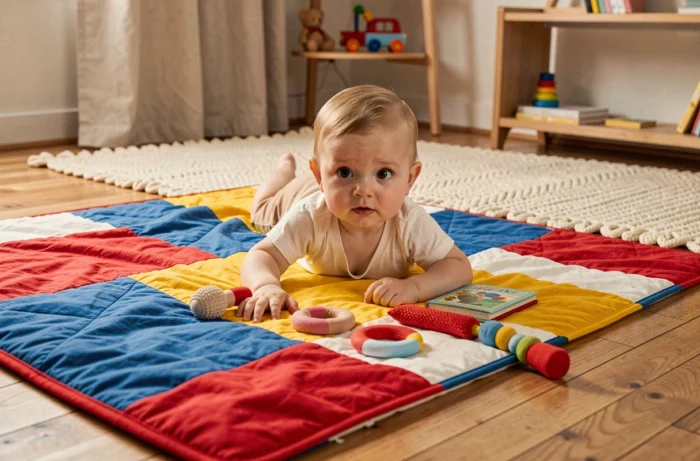
In practical terms, a colorful awakening space benefits from remaining free of artificial blue light sources. LED toys with white light deserve the same caution as tablets.
Creating a Sensory Exploration Environment Without Overload
The temptation to multiply stimuli (sound toys, varied textures, colorful mobiles, mirrors) is common. Field feedback varies on the exact threshold of overstimulation, but several practical principles emerge.
- Limit the number of visible objects at any given time. Three to five items are sufficient for an infant under six months. Others can be stored and offered in rotation.
- Clearly separate the sleeping area (minimal, less colorful) from the awakening area (contrasted, textured). This distinction helps the baby associate each space with a function.
- Vary materials rather than just colors. A smooth fabric, a raw wood ring, and a rubber rattle offer more tactile stimulation than three plastic toys of different colors.
Regular rotation of toys maintains exploratory interest without cluttering the space. A baby who finds an object after a few days of absence rediscovers it with renewed attention.
Wall Colors and Textiles: Adapting the Palette to the Baby’s Age
Paints and textiles form the permanent backdrop of the environment. Their choice has a lasting impact, unlike toys that can be removed or replaced.
Walls and Visual Background
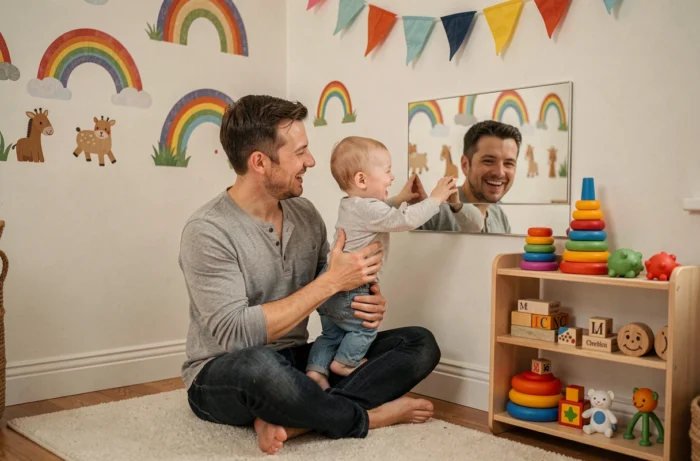
A light background (off-white, beige, very pale gray) remains the most versatile choice. It allows contrasting or colorful elements placed in the foreground to stand out without creating visual competition. A single accent wall in a soft color is enough to structure the space without saturating the infant’s visual field.
Dense, repetitive patterned wallpapers pose a specific problem: they become a permanent visual background that the baby cannot explore or ignore.
Colored Linens and Textiles
Sleep sacks, rugs, and cushions provide a more flexible lever than paint. They can be changed as the baby’s vision evolves.
- From birth to three months: high-contrast textiles (black and white stripes, simple geometric patterns).
- From three to six months: gradual introduction of bright colors on a neutral background.
- After six months: a more varied palette, more complex shapes, first textile picture books.
This progression follows retinal maturation rather than a purely aesthetic logic. Adapting textiles to each trimester is cheaper than repainting and produces a more targeted effect on awakening.
The choice of colors for the baby’s environment is not a matter of parental taste. It is primarily a question of physiological timing. An environment that respects the stages of the infant’s vision, limits sources of blue light, and moderates stimulation rather than piling it on, lays a more solid foundation than an Instagram-ready room where everything is colorful from day one.


