A three-year-old child who refuses to sit down to “make letters” on a blank sheet, we all know this situation. The problem rarely stems from a lack of interest in the alphabet: it’s the medium or method that doesn’t align with their need to move, touch, and test. Learning the letters of the alphabet starts with the body and the senses, long before the pen.
Tracing letters in sensory materials before paper
In the field, both in kindergarten and at home, a practice is gaining traction: tracing letters in sand, semolina, or mud. The idea is simple. You pour a layer of material into a tray, and the child draws the letters with their finger. The movement is broad, unconstrained, and mistakes disappear with a flick of the hand.
This sensory approach anchors the shape of each letter in motor memory. The child associates a trace with a tactile sensation, which reinforces memorization. Kindergarten teachers also use unusual surfaces (shaving cream on a table, finger painting on cardboard) to vary the textures.
At home, you can replicate this principle with a simple flour bin. The advantage: the child can start over as many times as they want without needing to prepare a new medium. Laminated and reusable sheets also allow for learning the alphabet with Declic Web by combining tracing with a wipeable marker and visual recognition of letters.
Alphabet and the child’s name: starting from what makes sense
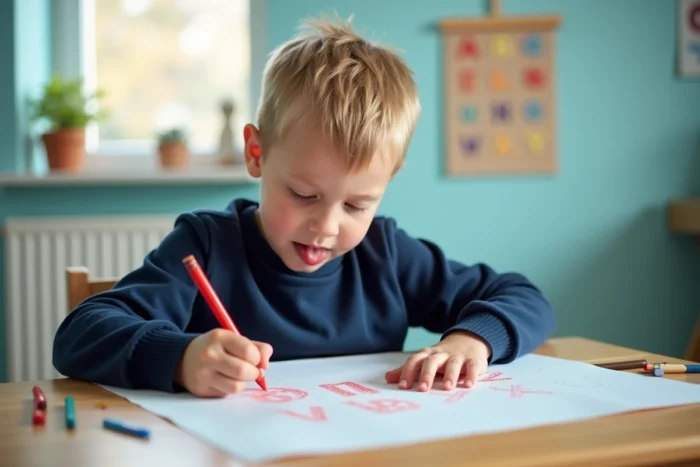
Starting with the 26 letters in alphabetical order is an adult reflex. For a child, the first letters that matter are those of their name. They carry an emotional weight; the child sees them written on their coat rack, their notebook, their drawings.
From the age of two, you can write the name in uppercase on a sheet and name each letter out loud. The child eventually recognizes them visually, then points them out in other words. “Look, the A in your name is also here, on this cereal box.” This spontaneous recognition in daily life turns every outing, every meal into a learning opportunity.
The name letter hunt game
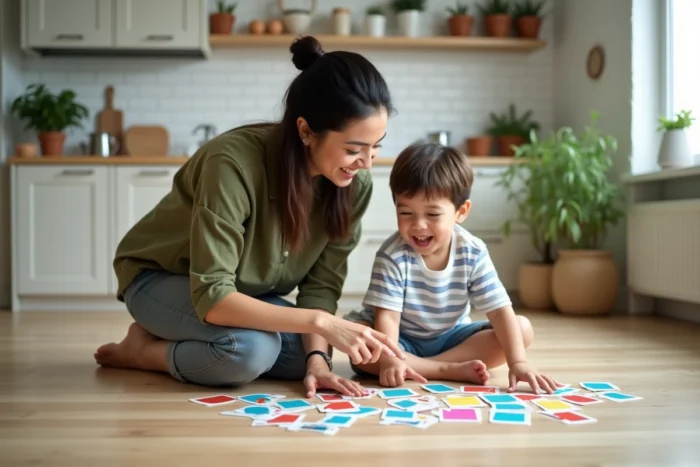
An activity that works well: print the letters of the name on cards, hide them in a room, and ask the child to find them to reconstruct their name. It combines visual memory, movement, and the satisfaction of “solving” something. Feedback varies on this point, as some children quickly lose interest if the name is short (three letters, the game is too quick), while others love to repeat the game over and over.
Moving from the name to the names of loved ones allows for gradually expanding the repertoire of known letters. The brother, the sister, the cat: each name brings its share of new letters to identify.
Laminated and reusable materials for repetition without frustration
The fear of “failing” holds back many children. A poorly traced letter on a beautiful white sheet is a visible failure. Laminated materials change the game: you write with a wipeable marker, erase, and start over. The mistake becomes invisible, and the child dares more.
For a few years now, laminated cards with the dotted tracing of each letter have been easily available. The child follows the path with their finger or a marker. These materials work particularly well for letters that children often confuse (b and d, p and q), because they can be compared side by side.
- Dotted tracing sheets guide the writing direction of each letter, preventing the development of poor graphic habits from the start
- Laminated wall posters keep the alphabet visible at all times in the bedroom or kitchen, promoting regular and passive contact with the letters
- Manipulable cards (one letter per card) allow for sorting games, memory games, or uppercase/lowercase matching
Nursery rhymes and sound games to associate letter and sound
Visually recognizing a letter is one step. Associating each letter with its sound is the true foundation of reading. Alphabet nursery rhymes remain a powerful tool for anchoring the order of letters, but they are not enough to work on phonological awareness.
A complementary exercise that yields good results: ask the child to name objects that start with a given sound. “Find something in the kitchen that starts with the sound [mmm].” The child explores, searches, and suggests “mug,” “mandarin.” We move from passive recitation to active searching.
Alternating listening and manipulation to vary the channels
A child who sings the alphabet but does not recognize the letter M on a page has not yet made the connection between the sound and the symbol. To strengthen this link, we can combine:
- A nursery rhyme that isolates the sound of the letter (not just its name)
- A card with the letter written on it that the child holds up when they hear the corresponding sound
- A playdough game where the child forms the letter after hearing it, engaging hearing, sight, and touch simultaneously
This type of short sequence (five to ten minutes) works better than long sessions. Regularity matters more than duration: a few minutes each day establish reference points that the child naturally recognizes.
Rhythm and daily life: integrating the alphabet without forcing
Transforming learning into a discreet ritual yields better results than a formal “lesson.” Naming letters on a package while shopping, spelling a word on a sign in the street, leaving magnetic letters on the refrigerator: these micro-moments accumulate.
The alphabet does not need a dedicated time slot. It needs to be present in the child’s environment, in varied and accessible forms. A poster in the kitchen, magnetic letters on the fridge, an ABC book in the bathroom basket. Repeated and relaxed exposure does more than any imposed exercise.
The most reliable signal that a child is progressing is not that they recite the alphabet flawlessly. It is that they spontaneously point to a letter in the street and announce, “That’s the S of Sarah.”