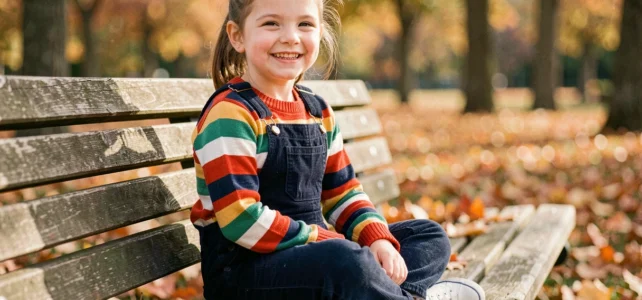
A snap-button pant that withstands three washes, a “stylish” t-shirt whose print cracks before the school year starts, a corded dress that the school rejects for safety reasons: we have all experienced this gap between the children’s clothing that looks good on the rack and what holds up in daily life. Dressing your children with style and comfort requires a different approach, starting from real constraints rather than trends.
Why stylish children’s clothing fails in real use
The problem often starts with cords and decorative elements. The European standard EN 14682 strictly regulates cords on children’s clothing to reduce the risks of strangulation and entrapment. This is not theoretical: recent recalls of costumes, such as the Marvel Spider-Man costume (reference 702072FR), have been reported non-compliant due to elements underfoot related to a risk of entrapment.
In practical terms, a hoodie with a drawstring or pants with dangling laces may be banned in certain schools and childcare facilities. You buy a look, and you end up with an unusable garment five days a week.
The other trap is dressing autonomy. A four-year-old who cannot button up or put on their boots alone wastes time every trip to the bathroom and every recess. Teachers repeat it: clothes that hinder autonomy end up at the back of the locker. Style is only valuable if the child can live in it without constant help.
Specialty shops like Jolis Mômes offer pieces designed to combine a polished look with child-friendly practicality, which avoids having to choose between the two.
Children’s clothing for school: the criteria that really matter
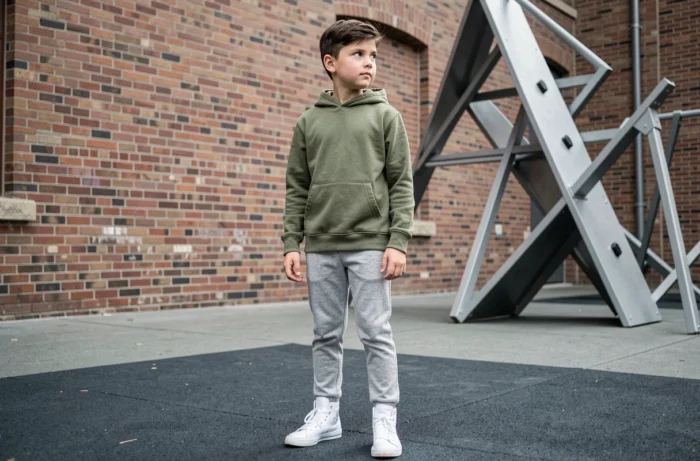
We think about color, pattern, cut. We should first think about the dressing sequence. A child in kindergarten must be able to put on and take off their clothes alone in less than a minute. This automatically rules out overalls with crossed straps, jeans with tight metal buttons, and dresses that are difficult to pull over the head.
What works in daily life:
- Elastic-waist pants, in jersey or stretch denim, that go up and down without help and follow movements on the ground, in the yard, or in the motor skills room
- Tops with wide necklines or snap buttons on the shoulder for the littlest ones, which avoid the struggle of getting the head through
- Layerable pieces (t-shirt, zip-up vest, jacket) rather than one thick piece, so the child can manage their own temperature
- Velcro shoes until lacing is truly mastered, often not before six years old
Style comes later through colors, piece combinations, and small details (contrasting pocket, colored bias) that do not hinder movement or autonomy. A successful look relies on well-cut basics, not on spectacular pieces that the child cannot wear alone.
Children’s textile labels: Oeko-Tex and GOTS do not guarantee the same thing
When we want healthy clothing for our children’s skin, we rely on labels. The problem is that we almost systematically confuse them.
Oeko-Tex Standard 100 tests the finished product against harmful substances (heavy metals, formaldehyde, certain dyes). It is a health filter, not an ecological label. An Oeko-Tex polyester can be perfectly safe for the skin while having a poor environmental record.
GOTS (Global Organic Textile Standard), on the other hand, certifies the entire supply chain: organic fiber, environmental production criteria, social conditions. A GOTS garment is necessarily made from organic fiber and has undergone checks at every stage.
For dressing children daily, the priority remains skin contact: Oeko-Tex class 1 (the most demanding, intended for babies) is sufficient for bodysuits, pajamas, and underwear. For a more comprehensive approach, GOTS provides additional guarantees, but often at a higher price. Feedback on this point varies by brand, with some offering GOTS at accessible prices through reduced collections.
Second-hand children’s clothing: what survives three children
Second-hand is no longer a backup plan. In France, platforms specializing in children’s clothing have multiplied, with sorting by size and age that simplifies the search. It is easy to find brand pieces in good condition for a fraction of the new price.
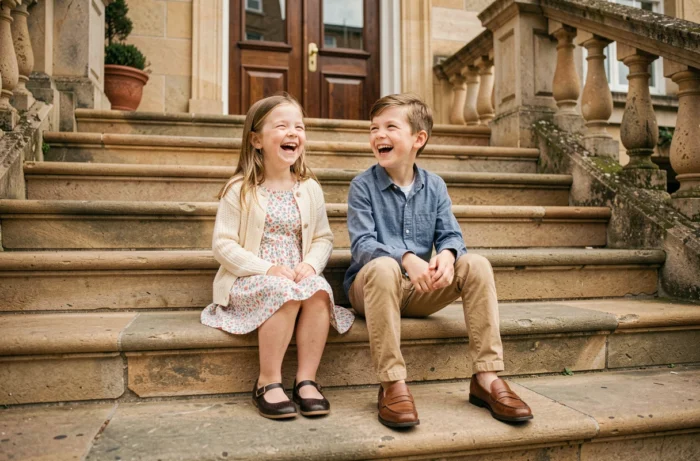
But not everything can be resold, and not everything can be passed down. The pieces that survive multiple children share specific characteristics: double stitching, thick cotton or brushed fleece fabrics, dark colors or patterns (which hide stains), and especially the absence of heat-pressed prints that crack during washing.
Pants with reinforced knees, fleece vests, and t-shirts with sufficiently dense jersey can easily last through three, sometimes four children. In contrast, glittery clothes, thin leggings, and “event” outfits that are rarely worn often end up unsellable in thrift stores.
Buying second-hand also changes the way a wardrobe is built. We aim for neutral pieces that can be combined with each other, in slightly loose sizes to extend usage. Style comes from the association, not from the isolated piece.
Building a sustainable children’s look without sacrificing style
The capsule logic adapted for children
Building a functional children’s wardrobe means selecting about ten pieces that all combine with each other. Three or four bottoms (stretch jeans, canvas pants, joggers), four to five tops (plain t-shirts, a sweatshirt, a soft shirt), and two jackets cover the week without visible repetition.
Loose cuts and adjustable clothing extend usage by one to two sizes. Some brands offer hems that can be unfolded, adjustable belts, or adjustable straps that accommodate growth without compromising the silhouette.
Children’s accessories: the detail that changes the outfit
A colorful hat in winter, patterned socks, a well-chosen backpack: accessories allow for personalizing a look without touching the basics. It is also the simplest way to let the child express their tastes. A boy or girl choosing their dinosaur socks or polka dot headband takes ownership of their outfit without sacrificing comfort or practicality.
Ultimately, true children’s style is less about the clothing than about how it supports the day: free to move, easy to put on, resistant to falls and stains, and passable down to a little brother or sister. A good children’s garment is one that you forget you are wearing.