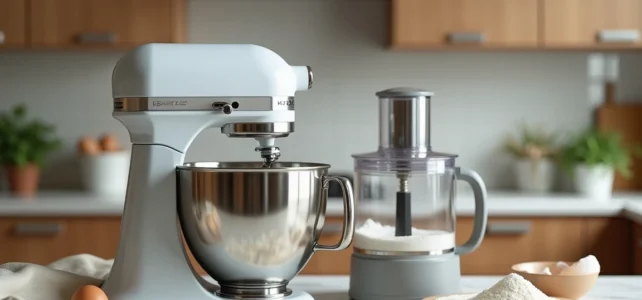
Stand mixers and Thermomix serve distinct roles in a kitchen, but their territories are increasingly overlapping. Comparing these two devices requires accurately measuring what each does better than the other, by cross-referencing mechanical power, cooking capacity, medium-term reliability, and actual cost over several years of use.
Reliability of kitchen robots: measured differences between brands
Before even comparing functions, a criterion often overlooked deserves to open the analysis: the actual durability of the devices. Data reported by Top Santé, derived from surveys by 60 Millions de consommateurs, reveal marked differences.
| Brand | Reliability Score | Comment |
|---|---|---|
| Moulinex (Companion) | 95.5 % | Best score among tested cooking robots |
| Thermomix TM6 | 91.3 % | Improving after two years deemed disappointing |
| Bosch | 63.7 % | Low score, problematic for intensive use |
A classic stand mixer (KitchenAid, Kenwood) does not appear in this ranking focused on cooking robots. Its simpler mechanics (motor, gears, bowl) generally provide high longevity, provided that an entry-level model is not used for heavy doughs.
To deepen the functional comparison, the stand mixer or Thermomix according to Cookinette details the use cases where each device has the advantage.

Stand mixer or multifunction cooking robot: what each motor can do
The stand mixer is designed around a planetary motion. The whisk, hook, or paddle rotates on itself while describing an orbit in the bowl. This movement ensures homogeneous kneading of heavy doughs (bread, brioche, pizza dough) and effective aeration of egg whites or whipped cream.
The Thermomix and its equivalents (Moulinex Companion, Kenwood Cooking Chef) use a high-speed rotating knife, complemented by integrated heating. Program-controlled cooking is their structural advantage: risottos, soups, sauces, steaming.
Pure pastry: advantage to the stand mixer
In intensive pastry tasks, the stand mixer remains superior. Its wide bowl and planetary motion allow for working large volumes of dough without overheating the motor. The Thermomix can knead, but its smaller bowl capacity limits the quantities. Whipping a French meringue in a stand mixer bowl takes just a few minutes and produces a light and stable result.
Cooked dishes and cooking: advantage to the Thermomix
The Thermomix excels at controlled-temperature cooking. Sautéing an onion, adding broth, cooking a risotto for twenty minutes without supervision: this scenario is unattainable for a classic stand mixer, which does not heat. The integrated steam basket further expands the range of possible recipes.
Actual cost over five years: stand mixer versus Thermomix
The initial purchase price does not summarize the total expenditure. A mid-range stand mixer costs significantly less than a Thermomix, but the comparison must include accessories and the recipe ecosystem.
- The stand mixer often requires the separate purchase of accessories (food processor, citrus juicer, pasta roller) to compete in versatility. Each piece adds to the bill.
- The Thermomix includes most of its functions in the base price, but access to the guided recipe platform (Cookidoo) relies on an annual subscription.
- An alternative multifunction cooking robot (Companion, Cooking Chef) is positioned at an intermediate price point, with pastry accessories sometimes sold separately.
When reduced to five years of daily use, the cost gap narrows if one adds the accessories of the stand mixer. However, for exclusively pastry use, the Thermomix represents a difficult-to-recover overinvestment.
Footprint and daily maintenance: an underestimated parameter
A stand mixer occupies a modest footprint but remains heavy (often over five kilograms). It stores easily on a countertop and its bowl is dishwasher safe.
The Thermomix and its multifunction competitors are bulkier. Their bowl, equipped with seals and a removable knife, requires more meticulous cleaning. Some models offer a self-cleaning program, but the internal parts (seals, lid, steam basket) require regular manual maintenance.
Maintaining the rotating knife requires precautions: removing it, cleaning it, checking the wear of the seals. On a stand mixer, the whisk or hook rinses in seconds.
Connectivity and guided programs: a selection criterion for beginners
The Thermomix TM6 and the recent TM7 feature a touchscreen and Wi-Fi connection. Step-by-step guided recipes automatically adjust the temperature, speed, and duration. For a beginner cook, this assistance significantly reduces the risk of error.
The stand mixer, on the other hand, does not come with any software intelligence. One must visually recognize the right consistency of a dough or meringue. This manual know-how is both its limit and its appeal for pastry enthusiasts who want to progress technically.
Hybrid models like the Kenwood Cooking Chef Experience attempt to merge the two worlds: planetary motion, integrated cooking, and pastry accessories. Their price is in the same range as the Thermomix, but they offer a larger bowl and a kneading mechanism closer to that of a traditional stand mixer.
The choice ultimately comes down to a question of dominant use. A household that cooks complete meals every evening will benefit more from a multifunction cooking robot. A regular pastry chef who kneads, whips, and aerates preparations will find in the stand mixer a more precise and durable tool for that purpose. Buying both remains an option, provided there is enough countertop space to accommodate them.