
The connected habitat refers to a home equipped with communicating devices (thermostats, sensors, locks, shutters) capable of exchanging data among themselves and with the occupant. In 2026, this sector will undergo a regulatory and technical transformation that redefines how devices work together and how data flows within the home.
EU Data Act and connected habitat: what changes on September 12, 2026
Most articles about smart homes discuss protocols or voice assistants. Few mention the legal framework that will concretely modify the functioning of connected objects in Europe.
As of September 12, 2026, the EU Data Act mandates access by design for any connected product sold on the European market. Each device must be designed so that the user can access, free of charge and by default, the data generated by its use. This data must be provided in a structured and machine-readable format.
For a thermostat or an indoor air quality sensor, this means that the occupant can retrieve their consumption history, temperature readings, or operating cycles without depending on the manufacturer. They can then export this data to a third-party service, for example, to optimize their energy management or plan maintenance for their installation.
Non-compliant products risk being banned from the market, recalled, or subjected to penalties. Home automation manufacturers must therefore adapt their firmware and cloud platforms before this deadline. To keep up with these regulatory and technical developments, Mon Habitat Web news regularly covers the topic.
This regulation overlaps with the GDPR: data from the connected home falls under both frameworks simultaneously. A presence sensor, for example, generates usage data (covered by the Data Act) that may also constitute personal data (covered by the GDPR). Manufacturers must therefore ensure portability without compromising privacy protection.
Matter Protocol and interoperability of home automation devices
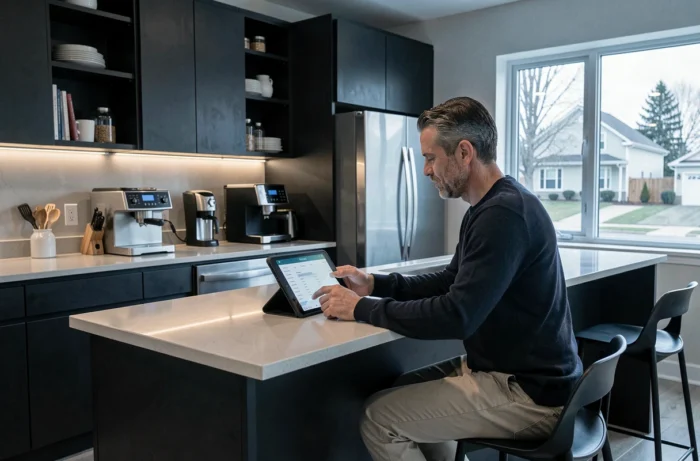
Until recently, connecting devices from different brands required juggling multiple applications and gateways. The Matter protocol, supported by major industry players, changes the game.
Matter operates on a local network, without systematically relying on the cloud. A compatible sensor communicates directly with a controller or assistant, regardless of the manufacturer. This approach reduces latency and limits data exposure to remote servers.
In practice, interoperability is improving but remains partial. Some advanced functions (complex scenarios, fine energy management) still require proprietary gateways. Choosing a Matter-compatible ecosystem does not exempt one from checking the precise list of supported devices before investing in an installation.
What Matter does not yet resolve
The protocol standardizes communication between devices, not the user interface. Two different applications can control the same Matter devices without providing the same experience. The quality of the control software remains as critical a selection criterion as hardware compatibility.
Local artificial intelligence and energy management in the home
AI embedded in home automation devices processes data directly on the device, without sending it to a remote server. This local processing offers two concrete advantages for the habitat.
- Responsiveness increases: a thermostat that locally analyzes heating habits adjusts the temperature without waiting for a response from the cloud, even in the event of an internet outage.
- Privacy is enhanced: presence, consumption, or daily routine data do not leave the home.
- The energy consumption related to data transfer to remote servers decreases, aligning with the building’s energy efficiency goals.
Local AI transforms the thermostat into a predictive tool. Instead of reacting to a fixed command, the device anticipates needs based on actual occupancy, weather, and the building’s thermal inertia. Several manufacturers are now integrating this capability into their consumer product lines.
This approach aligns with the requirements of the Data Act: since the data remains on the device, its portability must be ensured through structured exports, not by accessing the manufacturer’s cloud.

Next-generation sensors for indoor air quality
Connected sensors dedicated to indoor air now measure much more than temperature and humidity. Recent models detect volatile organic compounds (VOCs), CO2, fine particles, and sometimes radon.
These sensors automatically trigger ventilation or alert the occupant when a threshold is crossed. In a well-insulated home, where natural air renewal is limited, this function becomes a real lever for health and well-being.
Miniaturization allows these sensors to be integrated into discreet housings, compatible with existing home automation ecosystems. Some communicate via Matter, others via Zigbee or Z-Wave. Before purchasing, checking the supported protocol avoids multiplying gateways in the installation.
Maintenance and reliability of sensors
An air quality sensor loses accuracy over time. High-end models include automatic calibration, but entry-level models require manual recalibration or periodic replacement. This maintenance cost is rarely mentioned in product specifications.
The European regulatory framework, between the Data Act and GDPR, pushes the connected habitat towards greater transparency and portability. Protocols like Matter simplify installation, and local AI makes energy management more precise. The point of vigilance remains the actual lifespan of sensors and the effective compatibility between devices, two aspects that only a careful examination of technical specifications can evaluate before purchase.


