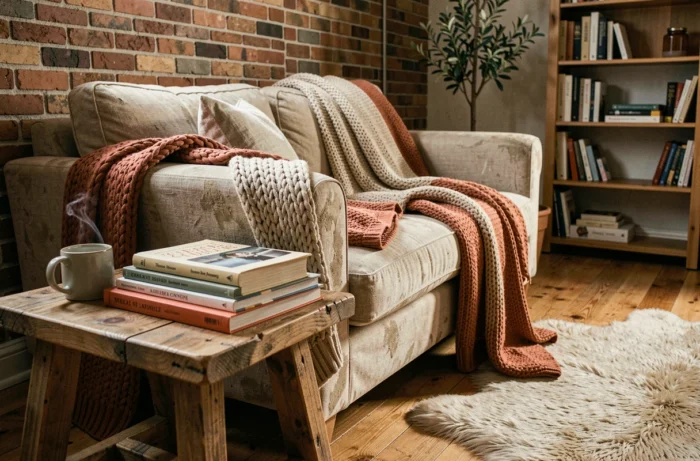
Creating an enveloping atmosphere at home is not just about piling cushions on a sofa. Cocooning decor, influenced by trends like Scandinavian hygge and japandi, has established itself as an enduring trend that goes far beyond the cold season. Specialized eco-friendly home brands confirm a decline in laminate materials in favor of solid wood and raw materials, indicating that the search for warmth in interiors meets a lasting need.
At the same time, regulations are pushing for a rethink of thermal comfort. The RE2020, mandatory for new constructions with permits filed since January 1, 2022, introduces an indicator of summer comfort measured in degree-hours of discomfort. Therefore, the warm cocoon of tomorrow must also protect against high heat, changing the way materials and layouts are chosen.
Thermal comfort and cocooning ambiance: what RE2020 changes concretely
Most decor guides treat the cozy ambiance as a purely aesthetic question. Regulatory constraints tell a different story. RE2020 adds two criteria to the previous framework: the building’s carbon footprint and summer comfort. Texts from 2024 have further strengthened carbon thresholds and the consideration of high heat.
For a renovation or construction project, this means that the choice of flooring, insulation, or interior wood cladding is no longer just a matter of style. Solid oak flooring or lime plaster contributes to the hygrometric regulation of a room, improving perceived comfort without resorting to air conditioning.
Practical guides published on the Scoopium home site detail how to balance aesthetics and performance when designing your living room or bedroom. This question deserves to be raised early in a project because a lime-plastered wall is not decided at the same stage as a cushion.

Natural materials and color palette: choices that anchor a cozy interior
Japandi and hygge share a common foundation: raw materials paired with a muted color palette. Light wood, raw linen, boucle wool, terracotta—these textures create a warmth that synthetic materials cannot replicate.
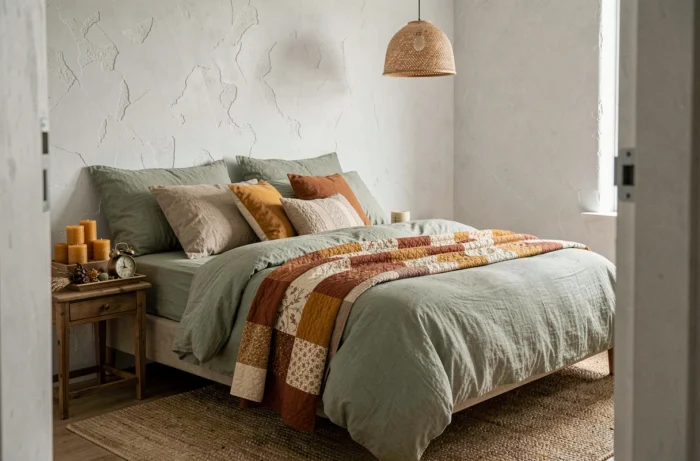
The choice of wall color conditions the entire atmosphere of a room. Terracotta, sage green, or off-white shades work because they absorb light rather than reflect it aggressively. A living room painted in pure white reflects light evenly, creating a clinical impression. A wall in soft ochre or greige produces the opposite effect.
Combining textures without overloading the space
A common mistake is to multiply materials without hierarchy. Three textures are enough to add depth to a living room:
- A dominant material on the floor (parquet, tiles, thick wool rug) that occupies the largest area and sets the overall tone.
- An intermediate material on the furniture (linen for the sofa, wood for the coffee table) that visually structures the space.
- An accent material on accessories (corduroy cushion, twisted knit throw, handcrafted pottery) that adds the finishing touch without cluttering.
Limiting materials to three registers avoids a cluttered effect and allows each element to breathe. The eye needs resting zones for the overall feel to appear warm rather than confusing.
Soft light and indirect lighting: the most underestimated element
An interior can have all the right materials and still miss its ambiance due to poorly thought-out lighting. The central ceiling light, still very common in French homes, produces flat light that flattens volumes and eliminates contrasts.
Multiplying low light sources radically transforms the atmosphere. A lamp on a console, a warm white LED string behind a shelf, a candle on the coffee table: each light point creates an intimate zone. The goal is to achieve islands of light rather than uniform lighting.
Color temperature: a technical criterion not to be overlooked
Light bulbs differ by their color temperature, expressed in kelvins. For a cocooning ambiance, feedback converges towards low-temperature bulbs that lean towards yellow-orange. A bulb labeled “cool white” gives a rendering similar to that of an office or supermarket.
Dimmers allow for adjusting brightness throughout the day. Lowering the lighting in the evening aligns with the biological rhythm and enhances the feeling of refuge, without heavy investment.
Cocooning furniture: warm wood, rounded lines, and durable pieces
Recent collections from major decor brands confirm a trend towards warm wood and Mid-Century aesthetics, featuring rounded lines and tapered legs. This is no coincidence: curved shapes soften the perception of a space and invite you to settle in.
A sofa with rounded armrests, an oval walnut coffee table, a patinated leather club chair: rounded furniture reduces the visual rigidity of a room. The omnipresent right angles (walls, windows, screens) benefit from an organic counterpoint.
The durability of furniture also contributes to the atmosphere. A solid wood object that ages well, whose patina evolves, anchors an interior in time. Disposable particle board furniture has the opposite effect: it degrades quickly and ultimately tarnishes the entire room.
Choosing a sofa suited to the actual use of the living room
The sofa remains the centerpiece of a cozy living room. A few concrete criteria help avoid mistakes:
- The seat depth determines actual comfort. A sofa that is too shallow prevents you from curling up, while one that is too deep requires constant adjustment of cushions.
- The upholstery affects maintenance. Removable linen can be washed, velvet attracts pet hair, full-grain leather ages beautifully but requires regular treatment.
- The density of the seat (high-resilience foam or pocket springs) ensures that comfort lasts beyond the first two years.
A well-chosen sofa remains comfortable for ten years, making it the most cost-effective investment in a cocooning decor project.
Transforming your interior into a warm cocoon relies on concrete choices: a contained color palette, three registers of materials, indirect low-temperature lighting, and rounded furniture made from durable materials. Thermal regulations push in the same direction, valuing natural materials capable of regulating comfort year-round. The result depends less on the budget than on the coherence of choices among themselves.


