
At 50 years old, the body absorbs vibrations, stationary weight, and prolonged positions on the saddle differently. Choosing a motorcycle at this age involves balancing three technical parameters: the riding position, the weight of the machine, and the power that can actually be utilized on the road. Comfort is not a luxury; it is a condition for riding safely over time.
Motorcycle Accident Rates Among Seniors: A Often Ignored Parameter
Content on the subject focuses on comfort and models that are easy to handle. They overlook a recent statistic. According to the ONISR barometer published in September 2026, the mortality rate for individuals aged 65 and older has increased by about 3% over the last twelve months compared to the previous period, and by 12% compared to 2019.
Even though this statistic encompasses all road users, it serves as a reminder that the risk increases with age, including for experienced motorcyclists. At 50, reflexes slow down, night vision declines, and recovery after a fall takes longer. Choosing the right motorcycle does not compensate for everything, but a poor choice amplifies every risk factor.
You can find more information on Ma Future Voiture regarding selection criteria suitable for those in their fifties.
Riding Position and Motorcycle Ergonomics After 50
The position on the motorcycle determines the fatigue felt after an hour of riding. Three main families are distinguished by the angle of the torso, the height of the footpegs, and the distance to the handlebars.
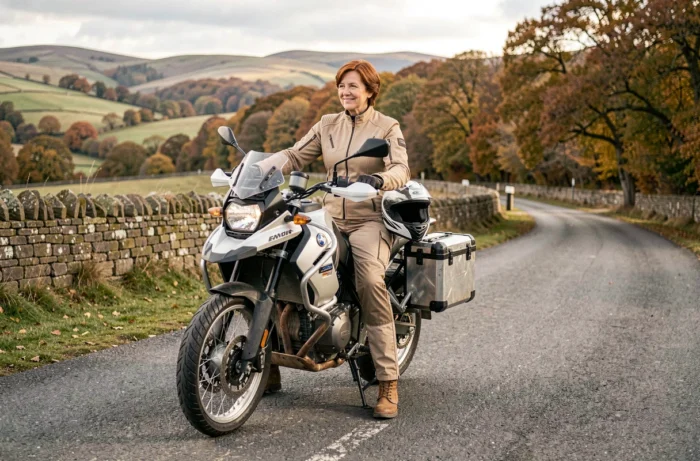
The upright position, typical of trails and roadsters, places the torso vertically with slightly bent arms. It relieves the lower back and allows the weight of the body to rest on the pelvis rather than on the wrists. For someone in their fifties who rides for several hours straight, this is the least aggressive configuration for the back.
The forward-leaning position of sport bikes puts strain on the neck and shoulders. After a few dozen minutes, the pressure on the wrists becomes problematic if the joints are sensitive. This should be avoided for road or travel use.
The rearward position of cruisers extends the legs forward. It seems comfortable when stationary, but it transfers part of the weight to the lower back during acceleration. On long trips, sciatica may protest.
Weight of the Machine: The Decisive Criterion When Stationary
On the road, the weight is forgotten thanks to the gyroscopic effect. The problem arises at low speeds and when stationary: parking maneuvers, U-turns on narrow roads, stops on inclines. A heavy motorcycle that tips over when stopped is difficult to recover, especially if muscle strength has diminished.
- Below 200 kg fully fueled, most motorcyclists in their fifties manage maneuvers without particular difficulty.
- Between 200 and 250 kg, the machine remains manageable as long as one practices regularly and masters low-speed counterweight techniques.
- Above 250 kg, every stop on sloped ground or soft surfaces requires attention. Seat height also plays a role: having both feet flat on the ground significantly reduces the risk of falling when stopped.
Before purchasing, testing the motorcycle in real conditions (sloped parking, U-turns on narrow roads) is worth more than all tests on open roads.
Motorcycle Categories Suitable for Those in Their Fifties
Rather than listing ten models, three categories deserve examination based on actual use.
Trail and Maxi-Trail for Travel
Upright position, long-travel suspension, wind protection with a tall screen. Trails remain the most versatile category for a 50-year-old motorcyclist alternating between roads, highways, and dirt paths. The BMW R 1250 GS has dominated sales in this segment among experienced motorcyclists for years. However, its weight exceeds 250 kg in running order, which makes it suitable for experienced riders.
Mid-Size Roadster for Mixed City-Road Use
A mid-sized roadster (around 700 to 900 cm³) offers an interesting compromise: manageable weight, upright position, and sufficient power for overtaking on national roads without excess. The Yamaha MT-07, regularly topping sales in France, exemplifies this category. Its reduced weight makes it maneuverable in the city while remaining stable on the highway.
Grand Touring for Long Trips in Pairs
Grand touring motorcycles feature wide seats, passenger backrests, hard luggage, and aerodynamic protections. Comfort is maximal on the highway, but the weight often exceeds 300 kg. This type of machine is suitable for those in their fifties who ride exclusively on paved surfaces and have maintained regular practice.

Motorcycle License and Medical Check-Up: What the Regulations Say
Contrary to what many believe, there is no mandatory medical check-up related to age for licenses A and B in France as of September 1, 2026. The license remains legally valid for life. Only the physical card must be renewed every 15 years through an online administrative process, without a medical examination or driving test.
Medical checks only become mandatory in case of declared or reported pathologies: epilepsy, severe balance disorders, visual impairments. The decision then rests with the prefect, with a visit to an approved doctor.
Nothing legally prevents a fifty-year-old from getting back on a motorcycle after a long break. A refresher course, offered by many motorcycle schools, allows one to reactivate skills without the pressure of an exam. It is an investment of a few hours that can prevent a fall during the first outings.
The choice of a motorcycle at 50 relies less on the brand or engine size than on the suitability between the weight of the machine, the riding position, and actual use. A test in slow maneuvering conditions, with feet on the ground, remains the best test before making any purchasing decision.


