
The question of when to separate a kitten from its mother arises whenever a litter is born at home or when an adopter spots an online ad. In France, the law sets a minimum threshold of 8 weeks to give up a kitten, but this legal floor does not align with the actual behavioral maturity of the little feline. Understanding the difference between nutritional weaning and social weaning helps avoid lasting issues.
Nutritional weaning and behavioral weaning: two distinct timelines
Recent veterinary sources emphasize a point that is often confused: nutritional weaning begins around three to four weeks, when the first teeth emerge and the mother gradually pushes the kittens away from nursing. The kitten then starts to taste solid food, first wet and then dry.
Behavioral weaning, on the other hand, extends well beyond that. Between the fifth and twelfth week, the kitten learns from its mother and siblings the social codes of cats: bite inhibition, frustration management, communication postures. A kitten fed alone from a bowl is not socially weaned.
Confusing these two stages leads to the belief that a six-week-old kitten, capable of eating kibble, is ready to leave the nest. Field reports vary on the exact timeline for the end of socialization, but most professionals place the reasonable age for separation between ten and twelve weeks. To know precisely when to separate a kitten from its mother, several behavioral criteria come into play.
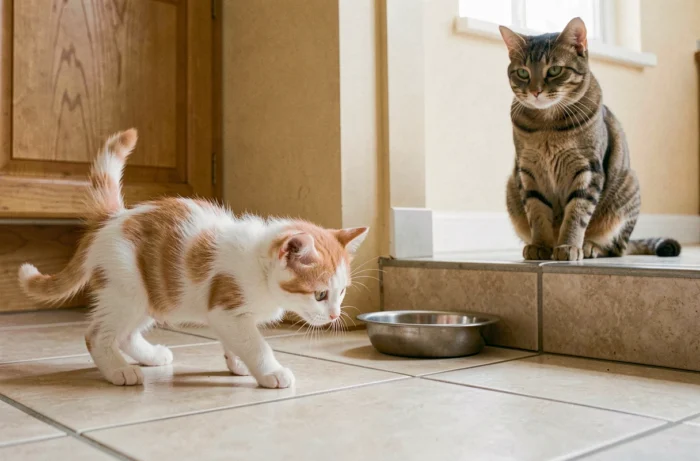
Separation at 8 weeks or 12 weeks: what an extra month changes
French legislation allows for separation as early as eight weeks. This threshold was set to regulate commercial practices, not to ensure appropriate development. An additional month with the mother alters several parameters.
- Bite inhibition solidifies between the eighth and tenth weeks: a kitten separated too early will bite harder while playing, sometimes even into adulthood.
- Stress management improves through imitation of the mother in response to noises, handling, and changes in environment.
- Cleanliness is generally acquired before eight weeks, but litter covering reflexes improve through contact with siblings.
- The immune system remains partially covered by maternal antibodies; a twelve-week-old kitten often receives its first booster vaccination before leaving, which secures the transition.
Waiting until twelve weeks reduces the risks of behavioral issues such as compulsive kneading, fabric sucking, or poorly calibrated aggression. These behaviors, common in kittens weaned too early, can persist throughout the cat’s life.
Found alone: should you intervene immediately?
Rescues and organizations remind us of a reflex that is often overlooked: a young kitten found alone outdoors is not necessarily abandoned. The mother may have gone hunting or moved the rest of the litter. Recovering the kitten too quickly can lead to unnecessary separation.
The current recommendation is to observe the area for several hours, or even half a day, before intervening. If the mother does not return, or if the kitten shows signs of distress (hypothermia, dehydration, continuous crying), intervention is justified.
An orphaned kitten under four weeks needs a bottle and constant warmth. Cow’s milk is unsuitable: only a specially formulated kitten milk meets the needs for taurine and fats. Veterinarians provide a precise protocol based on the estimated age.
The veterinarian’s role in estimating age
Weighing the kitten, examining its teeth, and checking its eye opening allows the veterinarian to estimate its age within a few days. This estimation determines the type of feeding, meal frequency, and vaccination schedule. Without this advice, the risk of underfeeding or overdosing a supplement remains real.
Preparing for the transition to the new home
Physical separation, even at twelve weeks, remains a stressful event. A few practical precautions can facilitate the kitten’s adaptation.
Recovering a cloth imbued with the scent of the mother and siblings helps reassure the kitten in the first days. Placing this cloth in the bedding limits nighttime meowing and searching behavior.
A unique, calm, and equipped room (litter box, food bowl, scratching post) constitutes the best welcome area. Gradually opening up the rest of the home over several days prevents overwhelming a kitten already destabilized by the loss of its social references.
The first veterinary appointment within the week following adoption allows for a general health check, planning for deworming, and adjusting the vaccination protocol. Recent guides recommend regular deworming starting in the first weeks, with a frequency adapted to the lifestyle (strictly indoors or outdoor access).
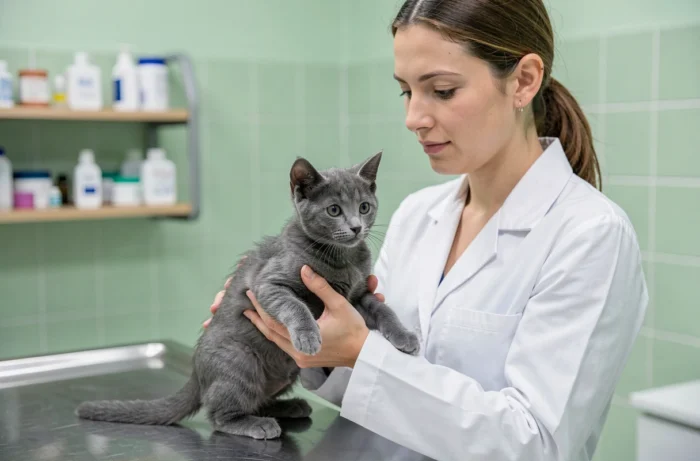
Post-weaning feeding: some guidelines
A twelve-week-old kitten eats three to four meals a day. Kitten kibble, richer in protein and calories than adult kibble, meets growth needs until about one year of age. Alternating wet and dry food promotes hydration, a sensitive point for cats.
The available data do not allow for a definitive choice between mixed feeding and exclusively dry feeding for all kitten profiles. The veterinarian is best placed to adjust the ration according to weight and breed.
Separating a kitten from its mother is less about a date and more about a set of signals: complete food autonomy, acquired social codes, up-to-date vaccinations. Respecting the kitten’s rhythm rather than a rigid schedule remains the best guarantee of a balanced cat in adulthood.