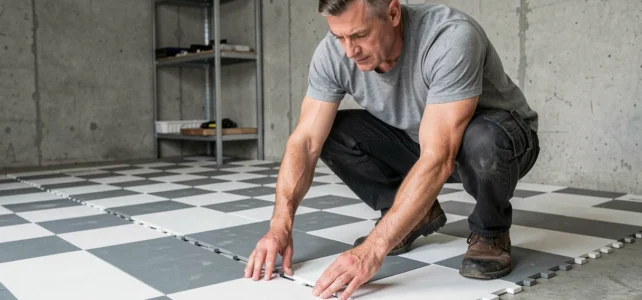
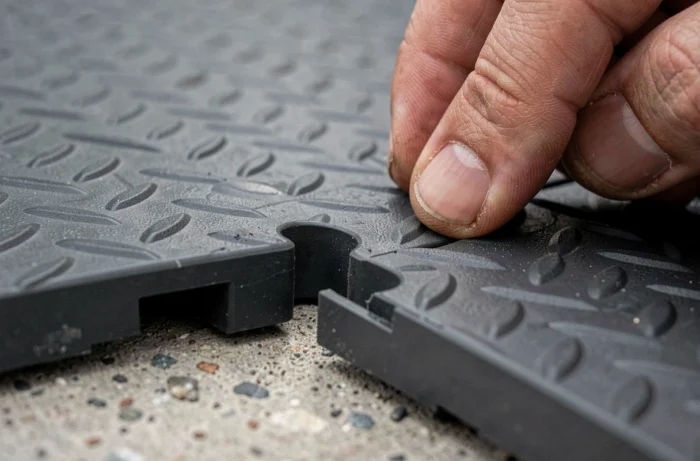
A click-lock PVC tile is a rigid tile, typically a few millimeters thick, whose edges interlock using a system of tongues and grooves without glue or screws. Laid directly on a concrete slab, it forms a removable floating covering. This simple mechanical principle explains why this type of flooring currently dominates the residential garage renovation segment.
Mechanical behavior of click-lock PVC on concrete slab
The raw concrete of a garage has two flaws that paint or resin do not correct: it generates dust through surface abrasion, and it transmits cold through direct contact. The click-lock PVC tile eliminates these two problems by interposing a polymer layer between the substrate and usage.
The rigid structure of the tiles distributes point loads. The weight of a vehicle is distributed over the tire’s contact surface, then across several adjacent tiles thanks to the interlocking that binds the whole together. Choosing a click-lock PVC tile for the garage allows for this structural continuity without prior leveling, provided that the substrate is flat and dry.
The chemical resistance of PVC is another technical advantage. Projections of engine oil, brake fluid, or gasoline do not attack the surface, unlike bare concrete that absorbs these fluids and stains permanently. A simple cleaning with water is sufficient in most cases.
Fire rating and VOC emissions: what product sheets do not always detail
The issue of fire safety in a garage is rarely addressed by installation guides. However, a garage stores flammable products (fuel, solvents, aerosols). Therefore, the fire behavior of the flooring deserves verification before purchase.
PVC and SPC tiles intended for the European market are tested according to the EN 13501-1 standard. The most efficient products achieve a fire rating of class B, which means a limited contribution to fire development and controlled smoke production. Not all manufacturers offer this level: some entry-level tiles fall into class C or D, with significantly less favorable behavior.
From a health perspective, quality tiles are tested for volatile organic compound emissions. The E1 category for formaldehyde indicates a very low emission rate. This point is particularly relevant when the garage communicates directly with the dwelling through an interior door, as VOCs migrate into the ambient air.
- Check the fire rating (EN 13501-1 standard) on the technical sheet before purchase, favoring class B
- Control the formaldehyde emission level (E1 category at a minimum)
- Request the test report if the manufacturer only mentions “compliant with standards” without specifying the class
Glue-free installation on garage floor: real constraints and limits
The main selling point of the click-lock tile is its quick installation, without special skills. On the ground, several conditions must be met for the result to be durable.
The substrate must be flat within a few millimeters. A marked deviation in flatness prevents the clips from engaging properly and creates play areas that will worsen under the repeated passage of a vehicle. On old cracked or uneven concrete, localized leveling may sometimes be necessary.
The moisture of the substrate poses a different problem than that encountered with a glued covering. Since the tile is floating, water does not compromise adhesion. However, moisture rising by capillarity can become trapped under the covering and promote mold. Tiles with a perforated structure on the underside or the installation of a polyethylene vapor barrier film resolve this difficulty.
The last point concerns thermal expansion. An unheated garage experiences significant temperature variations between summer and winter. PVC expands and contracts. A peripheral gap of a few millimeters along the walls is necessary to prevent the tiles from warping. Most manufacturers recommend not fixing rigid thresholds around the perimeter.
PVC tiles and high-end finishes: the rise towards LVT and SPC
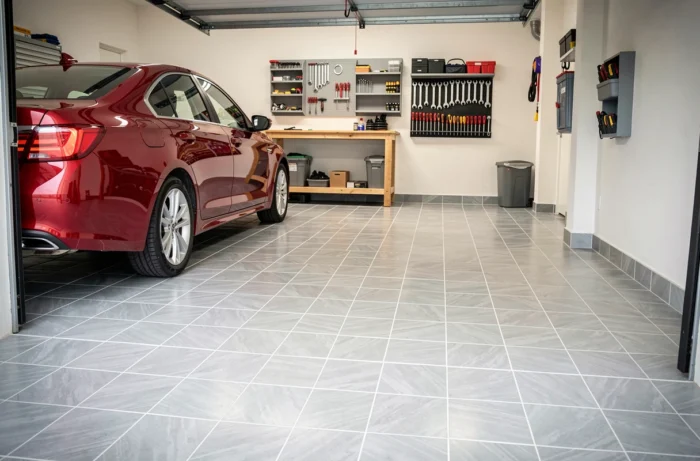
The market for click-lock tiles for garages is no longer limited to gray tiles with dots. The ranges of Luxury Vinyl Tile (LVT) and their SPC (Stone Polymer Composite) variants offer finishes that mimic waxed concrete, natural stone, or even textiles. This upgrade transforms the garage into a visual extension of the home.
The technical difference between a classic flexible PVC tile and an SPC tile lies in the core. The SPC incorporates a mineral filler (calcium carbonate) that stiffens the tile and improves its dimensional stability against temperature variations. For a garage, this increased rigidity is a direct advantage.
- Tiles with invisible joints offer a monolithic appearance similar to a poured floor, without the implementation constraints of a resin
- Textured finishes (wood grain, slate) provide natural foot grip, useful in a space where the floor may be wet
- Modular ranges allow for the combination of colors and patterns to visually delineate areas (parking, workshop, storage)
The segment is described as mature but in constant renewal. Manufacturers are gradually integrating environmental criteria (recyclability of PVC, reduction of emissions) that are expected to increase in the coming years.
The click-lock PVC tile is not a miracle product: it requires a correct substrate, a respected expansion gap, and verification of technical ratings. But once these prerequisites are met, it remains the only solution that combines reversible installation, resistance to hydrocarbons, and a refined finish without professional intervention.