
Curly hair loses its definition as soon as it undergoes prolonged pressure on the top of the head. The main issue with a classic cap is the rigid inner band that compresses the curls against the scalp and breaks their natural bounce. Finding a suitable model involves understanding what actually flattens the hair fiber, then choosing a shape, lining, and fit that preserve volume.
Friction and compression: what really flattens curls under a cap
Two distinct mechanisms damage curly hair under a head covering. The first is static compression: the cap’s band presses the strands on top against the skull, and the longer it is worn, the more the mark is imprinted in the hairstyle.
The second mechanism is friction. A rough fabric (raw cotton, untreated polyester) catches the scales of the hair with every micro-movement of the head. On a curl, this friction lifts the cuticle, generates frizz, and breaks the definition of the bounce.
Choosing a women’s cap for curly hair that is suitable means addressing these two fronts: limiting the surface area of rigid contact and reducing friction between the textile and the hair fiber.

Satin or silk lining: the technical criterion to check first
A satin or silk lining significantly reduces friction compared to a cotton interior. Satin, which is a type of weave rather than a material in itself, has a smooth surface on which the hair glides instead of catching.
Several brands now offer caps and bobs with a satin interior specifically designed for curly, frizzy, or locked hair. This manufacturing detail makes a real difference over a full day of wear: the curls maintain their initial shape when the cap is removed.
How to spot an effective lining
- Check that the lining covers the entire crown, not just the front band. A strip of satin limited to the forehead does not protect the curls on the top of the head
- Prefer a tightly woven satin rather than a thin and transparent fabric, which will lose its sliding properties after a few washes
- Test by touch: if your finger slightly catches on the inner surface, the fabric is not smooth enough for tight curls
Cap shapes suitable for voluminous hair
Beyond the lining, the shape of the crown determines the space available for the curls. A structured cap with a low panel mechanically compresses the volume, even with a satin interior.
High crown trucker cap
The mesh back panel offers greater internal volume than a closed cap. The curls on top of the head have enough space not to be flattened. The mesh also provides ventilation that limits humidity, an aggravating factor for frizz.
Unstructured baseball cap
Models known as “dad caps” or soft caps without rigid frames conform to the shape of the skull without imposing uniform compression. The absence of rigid structure allows the crown to adapt to the volume of the curls rather than the other way around. The adjustable back closure system (metal buckle or Velcro) allows for adjustment without tightening.
Women’s wave cap
Some recent sources highlight wave caps as an alternative for preserving curls and waves. These lightweight elastic fabric caps maintain definition without the weight or rigidity of a visor. Their use is primarily recommended at night to limit friction on the pillow, but some more structured models can be worn during the day as a style accessory.
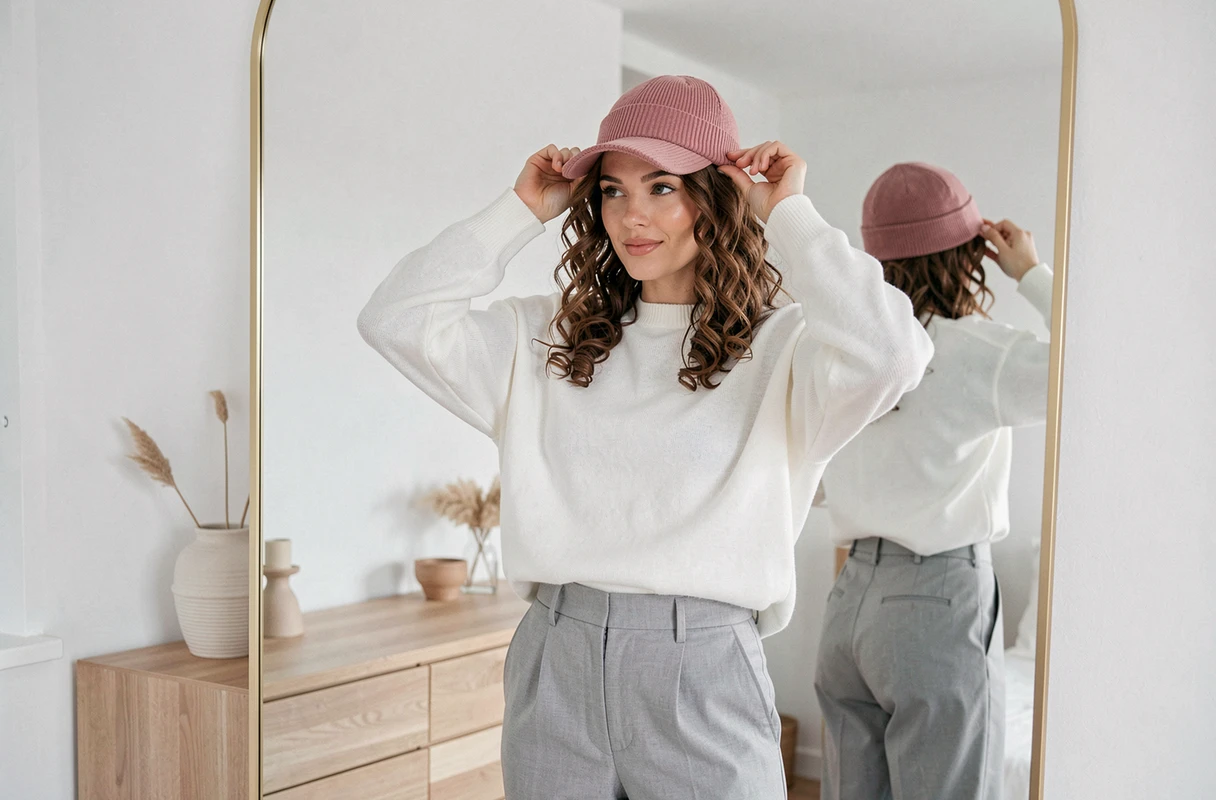
Hairstyling techniques for wearing a cap without flattening curls
Choosing the right model is not always enough. The way the cap is placed and how the hair is prepared directly influences the result at the end of the day.
- Place the cap slightly back on the head, leaving the front curls free under the visor. This position reduces the compression surface at the top of the head
- Use a satin scrunchie to gather the curls into a high, loose pineapple before putting on the cap, which concentrates the volume upwards without flattening the roots
- Avoid constantly repositioning the cap: each adjustment creates additional friction on different strands and multiplies frizz
- Apply a light veil of moisturizing hair oil on the lengths before prolonged wear, to strengthen the sliding barrier between the textile and the hair
Day wear versus night protection: two different logics
An often overlooked angle concerns the distinction between daytime accessories and nighttime protection. A cap worn outdoors serves an aesthetic and practical role (sun, wind). The priority is style, thermal comfort, and a fit that does not mark the forehead.
At night, the logic changes. A satin bonnet or wave cap protects the curls from friction against the pillow for several hours. Combining a suitable cap during the day and satin protection at night preserves curl definition over several days without having to restyle every morning.
This complementarity between daytime and nighttime accessories explains why a cap alone, even if well chosen, does not solve everything. A satin or silk pillowcase constitutes the third element of this protection routine, eliminating residual friction that neither the cap nor the bonnet covers.
Ultimately, choosing a cap for curly hair relies on three concrete parameters: a smooth lining, a sufficiently voluminous crown, and a closure system that adjusts without compressing. The rest is a matter of personal style and hair texture.