
Identifying the year of manufacture of a mobile home directly affects its resale value, insurance conditions, and compatibility with the regulations of many campsites. Several methods exist, from reading the chassis number to visual analysis of the model, but their reliability varies depending on the manufacturer and the condition of the mobile home.
Mobile home chassis number: decoding the year of manufacture brand by brand
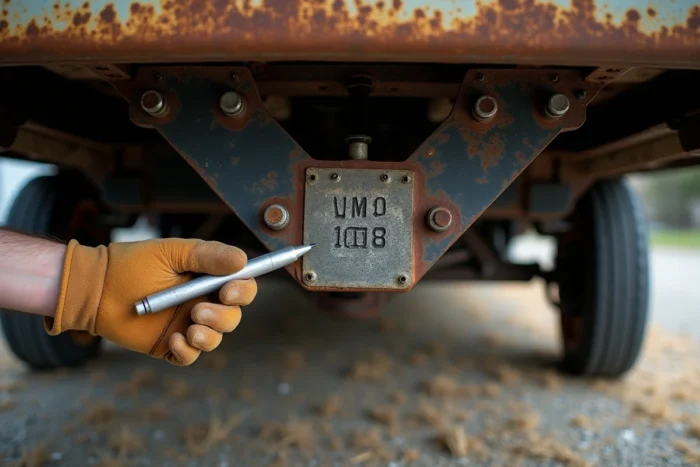
The most reliable method for dating a mobile home remains decoding its chassis number. This number, engraved on the metal chassis or reported on a riveted plate, contains information about the manufacturer, model, and, in most cases, the year of production.
At Louisiane, for example, the last digits of the chassis number generally correspond to the year of the mobile home. A chassis ending in “18” indicates it was manufactured in 2018. This logic is not universal: each manufacturer adopts its own coding structure.
| Manufacturer | Location of year code | Reading method |
|---|---|---|
| Louisiane | Last digits of the chassis number | Direct reading (e.g., “19” = 2019) |
| IRM (Beneteau Habitat) | Integrated into the chassis sequence | Cross-reference with manufacturer technical sheet |
| Rideau | Specific coding on chassis | Verification via dealer or manufacturer |
| Other brands | Variable | Contact customer service or specialized platform |
Specialized platforms like ID Plein Air document the specifics of chassis number locations by brand, allowing for cross-referencing with manufacturer technical sheets or market valuations. Several owners looking for tips for dating a mobile home would benefit from starting with this approach rather than relying on visual clues, which are often misleading.

Missing or illegible identification plate: the reidentification procedure
On mobile homes over fifteen years old, the identification plate may be corroded, torn off, or simply missing. This situation complicates dating and poses a concrete problem for resale or installation in a new campsite.
Several manufacturers and specialized sites then recommend a reidentification procedure using detailed photos. The principle: send the manufacturer or an authorized dealer precise pictures of the exterior, kitchen, bathroom, and interior layout. These elements allow for cross-referencing the model with period catalogs.
The information to provide for a complete reidentification:
- Exterior photos from multiple angles, including the type of cladding and roof shape
- Photos of the kitchen and bathroom (ranges visually change every two to three years)
- Dimensions measured in meters: overall length and width of the chassis
- Any remaining inscription on the chassis, even partial
This process generally takes several days, but it usually results in a formal identification of the model and year.
Visual clues to estimate the year of a used mobile home
When neither the chassis nor the plate provides usable results, observing the mobile home itself offers clues. Since the mid-2010s, French manufacturers have significantly evolved the design and layout of their mobile homes.
The location and style of the kitchen are a reliable marker. Older models often feature a closed or semi-open kitchen, while recent productions favor an open space connected to the living room. The type of exterior cladding has also changed: smooth PVC panels have gradually replaced corrugated sheets or wide horizontal slats.
Common visual dating elements
Joinery provides another clue. Single-glazed aluminum windows indicate an older model, while double glazing with PVC or powder-coated aluminum frames has become standard in more recent productions. The presence of an integrated terrace or structural awning also suggests a manufacture date after the mid-2010s.
These clues allow for an estimation range, not a precise year. A gap of three to five years is common with the visual method alone. It does not replace chassis decoding, but it helps detect inconsistencies when purchasing used (for example, a seller claiming 2015 for a model whose layout corresponds to 2008).
Cross-checking: technical sheets and market valuations
Dating by chassis or observation becomes more reliable when cross-referenced with technical sheets published by manufacturers. Sites like cotedumobilhome.com list models by manufacturer and year, along with associated characteristics: dimensions, number of bedrooms, type of insulation.
Cross-referencing the chassis number with the manufacturer technical sheet confirms or refutes the stated year. This verification is particularly useful in the used market, where the year of manufacture directly influences the price and the estimated remaining lifespan according to campsites.
- A mobile home over twenty years old is rejected by many campsites
- The resale value drops significantly after the first few years, then stabilizes
- Some campsites impose a maximum age for the installation of a used mobile home
The brand-based approach, which combines chassis, technical sheet, and visual observation, remains the most reliable for owners and buyers. Simply asking “what year is it?” to the seller is not enough: only documented verification protects the buyer against a dating error that could jeopardize installation on a campsite or obtaining suitable insurance.