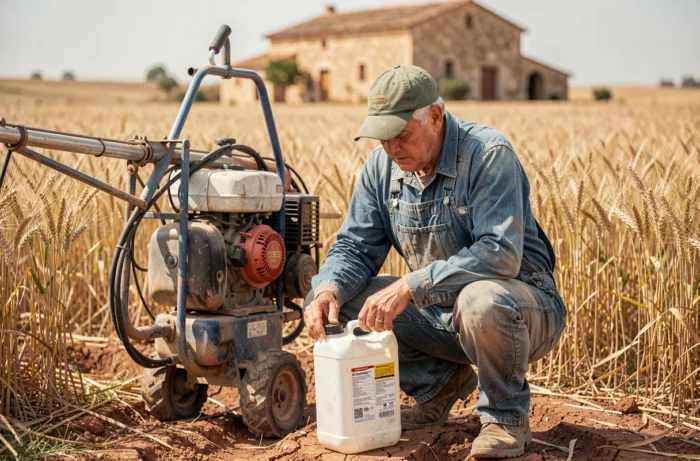
We know the scenario: a neighbor suggests pooling orders to fetch cans of glyphosate from across the Pyrenees. The price per liter drops, the trip is shared, and on paper, everyone benefits. In reality, the purchase group for glyphosate in Spain presents problems that the price per liter calculation does not capture.
Authorization of the substance and product authorization: the costly confusion
Most discussions on forums start from a shortcut: glyphosate is authorized in Europe, so it can be bought in Spain and brought back. This reasoning skips a step.
The European Union has renewed the approval of the active substance glyphosate. This approval does not automatically authorize every commercial product sold in garden centers or agricultural cooperatives. Each formulation must be approved at the national level, with uses, doses, and crops specified on the label.
The official register of the Spanish Ministry of Agriculture (MAPA) lists the authorized plant protection products in Spanish territory. A can purchased in Figueras or Irun may contain a formulation that is perfectly legal in Spain but has never been approved in France. Bringing it back means importing an unauthorized plant protection product, not simply transporting a tolerated substance.
Those considering buying glyphosate in Spain Agroterra will find a comprehensive analysis of the real purchasing conditions and pitfalls to avoid.
Glyphosate purchasing group: how volumes change the legal nature
An individual returning with a can in their trunk already takes a risk. A group organizing the purchase of several dozen liters changes the nature of the offense.
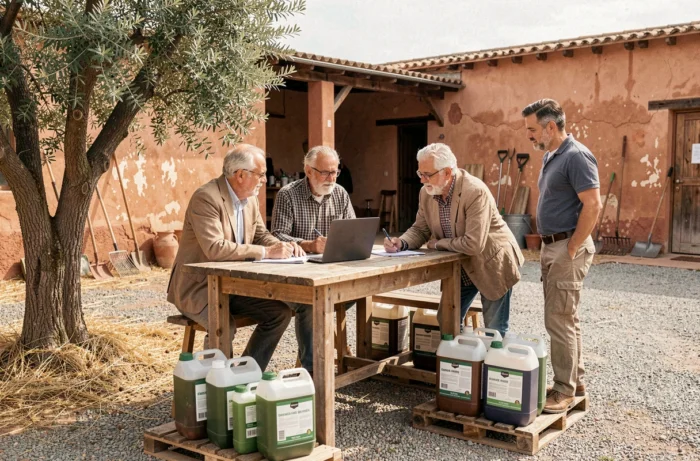
The volume transforms the contravention into a potential offense. When customs find quantities incompatible with occasional personal use, the classification can shift towards importation for distribution purposes. The penalties are no longer the same: it shifts from confiscation and a moderate fine to heavier prosecutions.
The very functioning of the group poses problems:
- The organizer who centralizes orders and redistributes the cans acts as a reseller of unauthorized plant protection products in French territory, even without a commercial margin.
- Traceability becomes impossible to ensure: no named invoice per end user, no tracking of batches, no guarantee on storage conditions during transport.
- In case of inspection or accident (spillage, pollution of a watercourse), liability falls back on the one who organized the purchase and distribution, not just on the end user.
It is often said that border controls remain rare. This is true for isolated crossings. But a group leaves digital traces (messages, transfers, participant lists) that can serve as evidence if an investigation is opened after a report or a random check.
Integrated pest management: the obligation that the group ignores
Spain is not the phytosanitary Wild West that some imagine. Royal Decree 1311/2012 imposes a framework of integrated pest management on Spanish farms. In practice, the use of glyphosate must be part of a documented strategy where alternative methods have been considered as a priority.
A group of French individuals buying in Spain finds itself in a blind spot: it is not subject to the Spanish integrated management framework (since it does not operate agricultural land in Spain), nor to the French pesticide usage framework (since the product has not been authorized for individuals there since 2019). Group purchasing creates a legal gray area that protects no one.
The date of 2033 guarantees nothing
The European approval runs until 2033, but this deadline does not prevent an early review. The European Commission can reassess an active substance before the renewal date if new scientific data justifies it. Building a purchasing habit based on a regulatory timeline is betting on a stability that the European framework does not promise.
Legal alternatives to glyphosate for non-agricultural surfaces
For individuals looking to weed paths, terraces, or gravel surfaces, biocontrol products based on pelargonic acid or concentrated acetic acid are authorized for sale in France. Their effectiveness is lower on deep-rooted perennials, but they cover the majority of common domestic uses.
Other approaches deserve to be combined:
- Thermal weeding (flame or steam) destroys the aerial part and is suitable for mineral surfaces, requiring a pass every few weeks depending on the season.
- Mechanical weeding (hoe, oscillating hoe) remains the most reliable method on small surfaces, with no residues or regulatory constraints.
- Thick mulching (wood chips, shredding, woven fabric) limits germination and reduces the need for intervention on flower beds and tree bases.
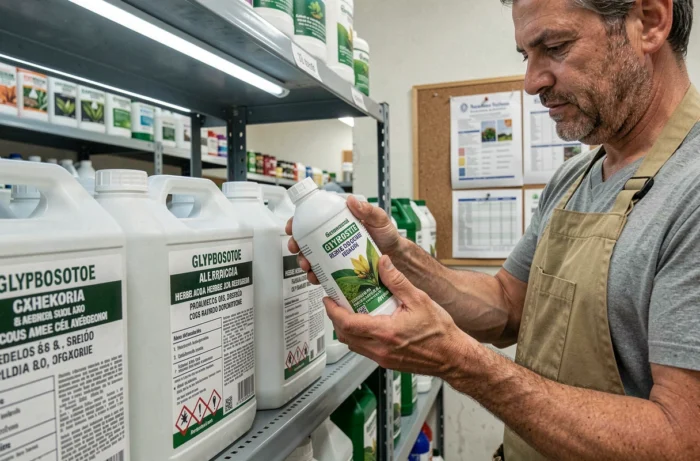
None of these methods replicate the systemic effect of glyphosate, which destroys the plant down to the root. On large surfaces or well-established weeds, feedback varies on the effectiveness of these alternatives. The compromise lies between immediate results and legal compliance.
Glyphosate in Spain: the real calculation before crossing the border
The price per liter displayed in Spain does not take into account the real cost of the operation. Fuel, travel time, the risk of confiscation at the border, and exposure to prosecution transform the apparent economy. For a group, one must add the responsibility of the organizer and the impossibility of guaranteeing that each participant will use the product under correct conditions.
Group purchasing amplifies every individual risk without providing additional protection. Before getting into the car, the calculation to be made is not that of the price per liter, but that of the consequences in case of inspection, a neighbor’s complaint, or accidental pollution of a water source.


