
An efficient garden relies less on the number of tools than on the technical relevance of each piece of equipment in relation to the soil, local climate, and actual tasks. We find that most buying guides pile up generic lists without addressing the criteria that make a difference in use: mechanical compatibility with the nature of the terrain, repairability, regulatory framework for powered devices.
Connected robotic lawn mowers: cybersecurity and regulatory compliance
Vision-guided robotic lawn mowers (without perimeter wire) represent a major technical shift. However, their connected dimension introduces a risk that product sheets do not mention.
Mammotion announces five years of security updates after market launch, which sets a software lifespan to consider in the investment calculation.
The regulatory framework will also change. Until January 19, 2027, these devices fall under the Machinery Directive 2006/42/EC. The European regulation 2023/1230 will then take over without national transposition, with enhanced safety and compliance documentation requirements. If you buy a robotic lawn mower today, check that the manufacturer explicitly commits to compliance with the new regulation.
We also recommend cross-referencing the equipment available on Spot Jardin with the manufacturer’s specifications before any powered purchase, to compare software support and spare parts guarantees.
Navigation in complex gardens
User feedback shows a concrete limitation of models without perimeter wire: managing irregular plots, slopes, and multiple flowerbeds. The choice directly depends on the topography. A L-shaped garden with shaded areas and curved borders will challenge most vision-guided navigation systems.
Before investing, map out fixed obstacles (trees, walls, raised vegetable beds) and assess the slope. A robot that performs well on flat terrain can become unusable on a slope exceeding the manufacturer’s threshold.
Noise regulations and powered garden equipment
Switching to electric does not exempt you from complying with local noise rules. In France, mowing hours can be regulated by municipal or prefectural decree. The legal criterion remains the actual disturbance caused to neighbors, not the type of energy used by the device.
A robotic lawn mower programmed to operate early in the morning or in the evening can generate complaints, even if its noise level is significantly lower than that of a gas mower. We observe that many owners neglect this check before purchase.
- Consult your municipality’s municipal decree to know the authorized time slots, including for electric devices
- Check the declared noise level of the robot (expressed in decibels) and compare it to the disturbance thresholds defined by local regulations
- Schedule mowing cycles during the middle of the day on weekdays to minimize neighborhood conflicts
Watering and water management: choosing a system suited to the soil
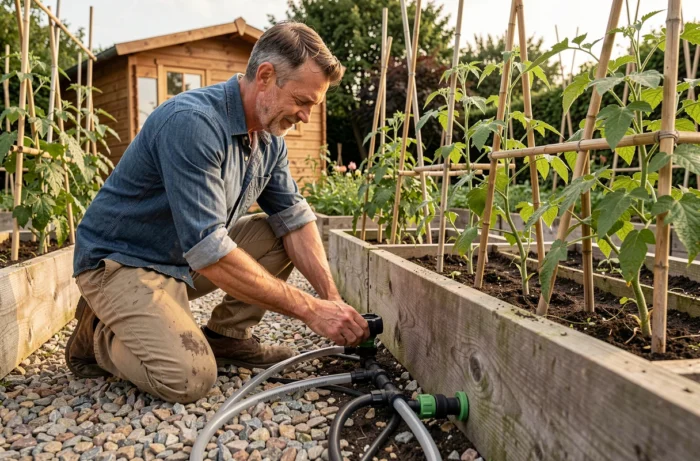
Watering remains the area where technical choice has the most impact on water consumption and plant health. An underground drip system has nothing to do with an oscillating sprinkler in terms of water efficiency, but it is not suitable for all soils.
In clay soil, drip irrigation concentrates water on the surface and can lead to root asphyxiation if the flow is not calibrated. In sandy soil, water percolates too quickly, and the system must compensate with more frequent cycles. The choice of irrigation system primarily depends on soil texture, not budget.
Timers and moisture sensors
Connected timers with integrated soil moisture sensors allow for real-time cycle adjustments. Their usefulness is maximized in regions with irregular rainfall, where fixed-time programmed watering wastes water after a downpour.
For a vegetable garden, we recommend placing the sensor at the root depth of the main crops (often between fifteen and twenty centimeters for common vegetables). A sensor that is too shallow triggers unnecessary watering.

Maintenance and repairability of garden tools: an underestimated criterion
The lifespan of a garden tool depends as much on its repairability as on the quality of its materials. A pruner with interchangeable blades and a replaceable spring will last several more seasons than a monobloc model sold at the same price.
- Prefer tools whose wear parts (blades, springs, seals, filters) are available separately from the manufacturer
- For powered devices, check for the existence of an authorized repair network or the availability of spare parts beyond the warranty period
- Electrical equipment falls under the WEEE directive: their end-of-life is regulated, and some distributors offer take-back when purchasing a new device
A repairable tool costs less over five years than a disposable tool replaced twice. This calculation applies to both the pruner and the robotic lawn mower. We find that manufacturers who publish their repairability indices and spare parts catalogs generally offer better value for money in the medium term.
Optimizing a garden on a daily basis involves precise technical choices suited to the reality of each terrain. The soil, local regulations, and the software or mechanical lifespan of the equipment are the three parameters to consider before each purchase. A well-chosen piece of equipment is recognized by the fact that you forget it is there because it simply does its job, season after season.


