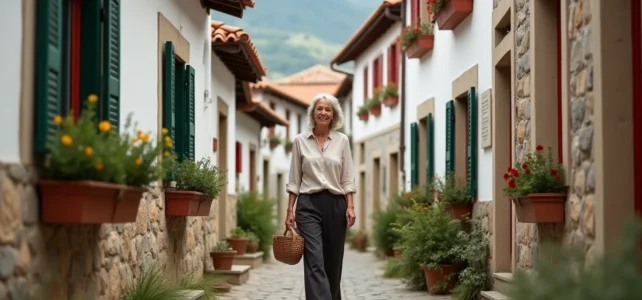
Dancharia attracts thousands of visitors each year who come to stock up or fill their trunks with Spanish products. However, behind this reputation as a border shopping area lies a small Basque hamlet of 39 inhabitants, attached to the municipality of Urdazubi (Urdax) in Navarre. What remains to be measured when comparing this tiny territory, perched at about 75 meters above sea level, to other cross-border stops in the Basque Country?
Dancharia compared to other border stops in the Basque Country
Travelers heading to Spain via the A63 or N10 often hesitate between several stops. The table below compares Dancharia, Béhobie-Irun, and Le Perthus based on criteria that matter to a transit driver.
| Criterion | Dancharia | Béhobie-Irun | Le Perthus |
|---|---|---|---|
| Administrative status | Hamlet of Urdazubi, Navarre | Border town, Guipuzcoa | Border municipality, Catalonia |
| Resident population | 39 inhabitants | Several tens of thousands | Several hundred |
| Altitude | About 75 m | Sea level | About 290 m |
| Dominant type of offer | Traditional ventas, Basque terroir | Shopping centers, large stores | Bazaars, perfumeries, alcohol |
| Atmosphere | Mountain hamlet, rural | Urban, dense | Linear commercial |
The most striking difference concerns scale. Dancharia concentrates its commercial activity within a tiny perimeter, whereas Irun offers an extensive urban fabric. For a traveler seeking Basque authenticity rather than mass distribution, this aspect changes the very nature of the stop.
Those wishing to delve deeper into the history and specifics of the village of Dancharia in Spain will discover a territory whose residential dimension remains almost invisible in the usual guides.
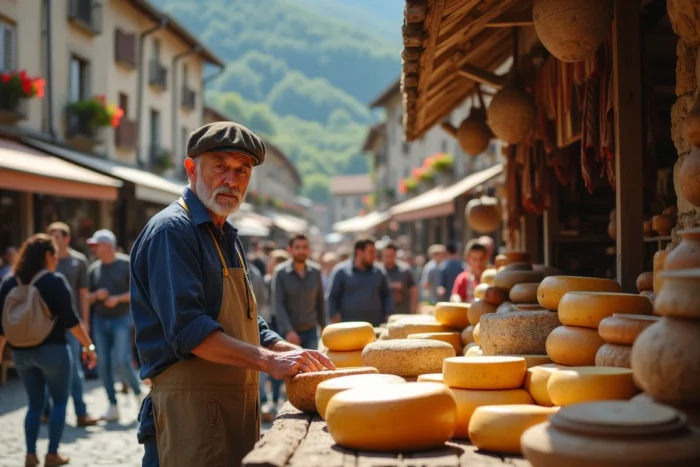
Dantxarinea, Navarre hamlet: what the administrative status reveals
Articles dedicated to Dancharia systematically refer to it as a “village” or “shopping area.” Neither of these labels corresponds to the administrative reality. Dantxarinea is a district of the municipality of Urdazubi, in the foral community of Navarre, not an autonomous entity.
This distinction has concrete consequences. Taxation, commercial opening hours, and urban planning rules depend on the municipality of Urdax. The ventas of Dancharia do not benefit from a specific derogatory regime: they follow Navarre regulations.
An imbalance between residents and visitors
With its 39 inhabitants, Dantxarinea welcomes a daily influx of visitors that far exceeds its population. This visitor/resident ratio places the hamlet in a unique category among European border areas.
Almost all local economic activity relies on cross-border trade. No town hall, no school, no post office: public services are located in Urdax, just a few minutes by car. The hamlet functions as a commercial extension attached to a rural municipality.
Hiking and exploration around Dancharia: a Basque Country on foot
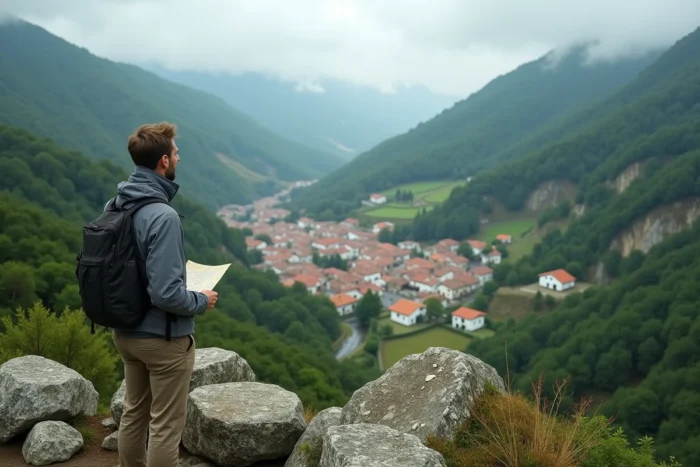
The modest altitude of Dancharia and its position in the Nivelle valley provide direct access to the trails of Labourd and Navarre. This is an aspect that shopping-oriented content almost entirely overlooks.
- The tour of the Dantxarinea quarries offers a marked route that crosses wooded hill landscapes, accessible without any special technical equipment
- The hiking paths to the Iraty forest, accessible from Navarre, allow for a transition in just a few hours to one of the largest beech forests in Europe
- The surrounding passes (Labourd, Baztan) offer starting points for day trips to mid-mountain peaks
Hiking is the true counterpoint to border shopping. A stop in Dancharia can combine a morning in the ventas and an afternoon on the trails, transforming a simple commercial detour into a full day in the Basque Country.
Navarre caves and underground heritage
In the immediate vicinity of Urdax, the Navarre caves represent a geological heritage often overlooked by passing visitors. These karst cavities can be visited in conjunction with a stop at Dancharia, without any significant detour.
This underground heritage, combined with hiking trails, positions the area as a starting point for discovering the Navarre Basque Country rather than just a commercial area.
Stay in Dancharia: accommodation and practical logistics
Staying on-site or in the immediate vicinity is possible, despite the size of the hamlet. Several campsites and guesthouses are located within a few kilometers, on both the French and Spanish sides.
- Campsites near Dantxarinea offer moderately priced pitches, with quick access to the commercial area and trails
- Traditional Basque house accommodations exist in Urdax and neighboring villages of Labourd (Ainhoa, Sare)
- Saint-Jean-de-Luz and Hendaye, about twenty minutes away, offer a wider range of hotels for those wishing to combine beach and border market
The choice of accommodation base depends on the length of stay. For a day, free parking is sufficient in the Dancharia area. For a multi-day discovery stay in the Basque Country, the villages of Labourd make for a better base camp, with Dancharia as a half-day excursion.
Dancharia remains a unique case in the Franco-Spanish border landscape. A hamlet of 39 souls that generates disproportionate commercial traffic, but also provides access, in just a few minutes on foot, to mountain trails and Navarre heritage that most visitors are unaware of.