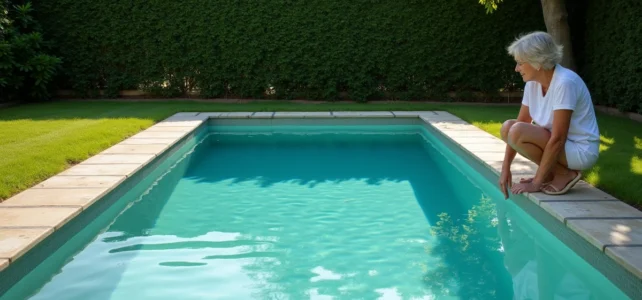
A 10 m² pool represents a basin size that sits right on a regulatory threshold. In France, the 10 m² pool surface area determines the obligation (or not) to submit a prior declaration of works and to pay the development tax. This administrative framework directly influences the choice of dimensions, sometimes more than the aesthetic or sporting preferences of the owner.
The regulatory threshold of 10 m² and manufacturers’ strategy
Staying just below 10 m² of pool surface allows one to avoid the prior declaration of works and the development tax. This point, often summarized in a sentence in general guides, deserves attention: a 9.5 m² pool and a 10 m² pool do not offer the same administrative situation.
Several manufacturers are now positioning models around 9.5 m², with dimensions like 4.3 x 2.7 m or 3.7 x 2.3 m. The goal is to offer a water surface almost identical to 10 m² while remaining below the threshold. This trend for 2025-2026 reflects a precise trade-off: sacrificing a few square decimeters of swimming space to simplify the administrative process.
Before setting your dimensions, it is therefore necessary to reframe the question. Choosing the size of a 10m² pool first involves deciding whether you accept the formalities related to crossing this threshold. A pool of 4.5 x 2.2 m (or 9.9 m²) and a pool of 5 x 2 m (exactly 10 m²) do not involve the same procedures, for a negligible surface difference in use.
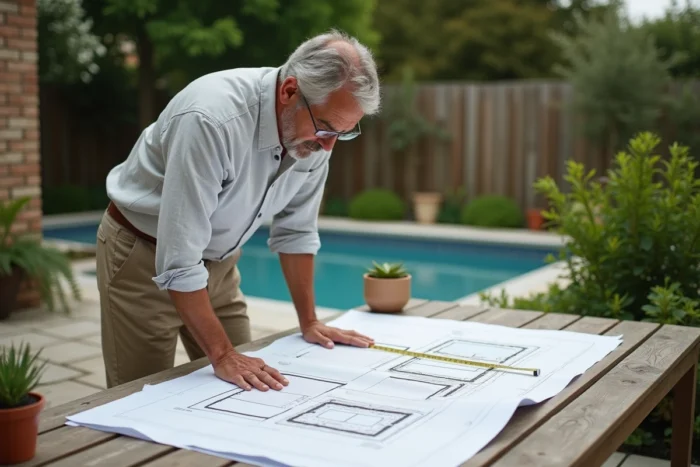
Length and width dimensions of a 10 m² pool: concrete combinations
Ten square meters can be a rectangle, a square, a bean shape, or a corridor. The shape conditions the use much more than the raw surface area. A basin of 5 x 2 m allows for some swimming movements. A basin of 3.3 x 3 m, with a nearly identical surface, is more oriented towards relaxation or play.
Elongated rectangle or compact basin
The most common configurations for approaching 10 m² fall into two categories:
- The elongated rectangle (5 x 2 m, 4.5 x 2.2 m): it allows for short swimming, sufficient for moderate exercise or the installation of a counter-current swimming system. However, the width of 2 m is tight for two people side by side.
- The compact basin (3.5 x 2.8 m, 4 x 2.5 m): it prioritizes shared swimming space. Two adults and a child feel more comfortable in it than in a corridor, but swimming is not feasible.
- The square (3.15 x 3.15 m): not common in polyester shells, it exists more in masonry construction or containers. The use remains oriented towards wellness or relaxation.
The length of the basin determines the main use: below 4 m, free swimming does not make sense. Above 4.5 m, it becomes possible with counter-current equipment.
Depth: an often underestimated parameter
For a 10 m² basin, the common depth ranges between 1.10 m and 1.50 m. A flat bottom at 1.20 m suits most family uses. An inclined bottom with a zone at 1.50 m allows for more comfortable swimming, but increases the water volume and thus the treatment and heating costs.
Field feedback varies on this point: some owners regret a flat bottom that is too shallow for swimming, while others feel that a depth greater than 1.40 m complicates monitoring children. The trade-off depends on the age of the users and the frequency of sporting use.
Circulation around the basin and actual footprint in the garden
A 10 m² basin does not occupy 10 m² on the ground. The actual footprint includes the beaches, the coping, the technical room, and the regulatory distances from property boundaries. In practice, a 10 m² basin requires a garden area of at least 25 to 30 m² to be installed under proper conditions.
The minimum peripheral circulation around the basin generally ranges between 1 m and 1.5 m. Below this, maintenance becomes difficult (passing the net, accessing the technical room, handling the cover). This perimeter is often overlooked when choosing dimensions: one selects a 5 x 2 m basin thinking it will fit in a 6 x 3 m space, without accounting for the cleanliness slab or the cover box.
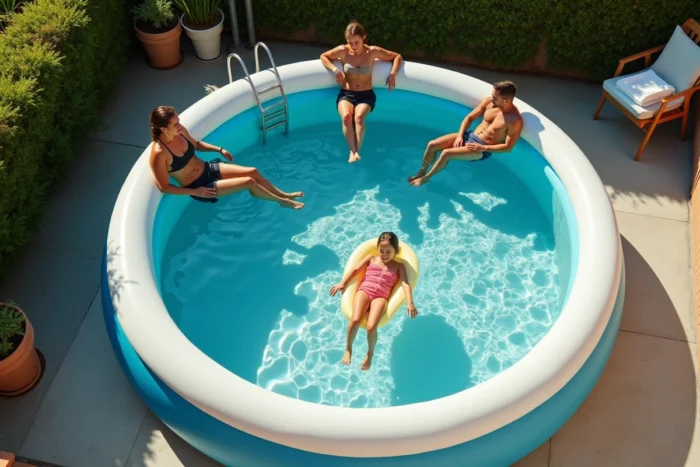
Distance to property boundaries
Even without a prior declaration (pool under 10 m²), local urban planning rules may impose a setback from fences. The Local Urban Planning Plan (PLU) of your municipality specifies these distances, which often vary between 1 m and 3 m depending on the zones. Checking this point before choosing dimensions avoids discovering, once the earthworks have begun, that the planned basin does not fit within the authorized envelope.
Shell, masonry, or container pool: which type for 10 m²
The choice of construction type directly influences the available dimensions. Polyester shell pools are delivered in predefined templates. For the 10 m² segment, manufacturers typically offer models ranging from 4 m to 5 m long and from 2 m to 2.5 m wide, with flat or slightly sloped bottoms.
Masonry construction (blocks, sprayed concrete) offers total freedom on dimensions, but the cost and duration of the project increase significantly. For a 10 m² basin, the shell remains the most frequent choice due to an installation time of a few days.
Container pools, which have recently appeared on the market, offer swimming surfaces close to 10 m² (for example, 4.5 x 2.2 m in usable surface). They are placed on a slab and quickly connected to utilities. The available data does not yet allow conclusions about their long-term durability compared to polyester shells established for several decades.
The 10 m² format remains a segment where regulatory constraints, terrain geometry, and usage type weigh as much as the budget. First, set the minimum acceptable length for your practice (swimming or relaxation), then check the total footprint in your garden and the position relative to the administrative threshold: it is in this order that the choice becomes coherent.