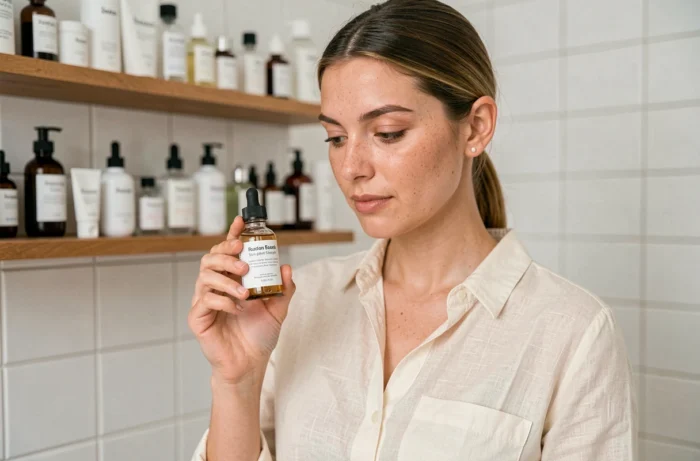
When you buy a lipstick or a serum at Nocibé, you rarely purchase just one brand. The store distributes dozens of different brands, each with its own policy regarding animal testing. Therefore, knowing whether Nocibé is cruelty-free involves asking a broader question than one might initially think.
Nocibé as a distributor and private labels: a distinction to understand
Nocibé is primarily a distribution network. The store sells products from third-party brands (fragrances, skincare, makeup) and also offers its own lines under its name. These two categories do not follow the same logic.
For third-party brands, Nocibé has no direct control over testing practices. A bottle sold on the shelf may belong to a group that markets its products in mainland China, where animal testing has long been required by local regulations. Another may be certified by a recognized cruelty-free label.
For its private labels, the question is different. If you want to know whether Nocibé is cruelty-free as a manufacturer, you need to check if its in-house ranges carry an independent label or if the store formally commits to the absence of animal testing at every stage, including on ingredients.
Without independent certification, a statement of intent is not enough. Labels like Leaping Bunny or PETA certification require audits and monitoring of the entire supply chain, which a simple marketing mention does not guarantee.
European regulations on animal testing in cosmetics
The European Union has banned animal testing for finished cosmetic products since 2004, and for cosmetic ingredients since 2013. This ban also covers the marketing of products whose ingredients have been tested on animals elsewhere in the world, specifically for cosmetic use.
But this protection has its limits. The REACH regulation, which governs chemical substances in Europe, can still require animal testing when an ingredient is used in both cosmetics and other sectors (industry, pharmaceuticals). An ingredient tested under REACH can end up in a cosmetic sold as “not tested.”
What has changed recently
The EU adopted a new political direction in 2026 to accelerate the phase-out of animal testing, with a roadmap focused on alternative methods and their regulatory validation. The Council of the EU also announced an agreement strengthening the role of the European Chemicals Agency in promoting non-animal approaches.
These advancements show that the European regulatory framework is not yet completely free of animal testing, even though the trend is clearly moving in that direction. A product sold at Nocibé and manufactured in Europe benefits from these protections, but they do not cover all scenarios.
Cruelty-free and vegan labels: how to read labels in-store
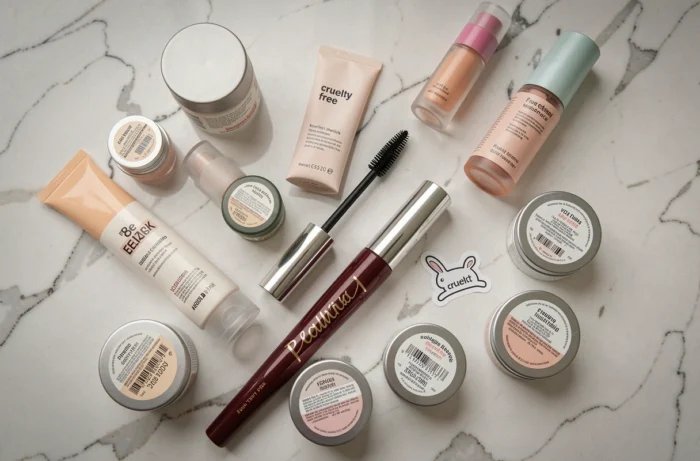
Have you ever noticed a small stylized bunny on a package? This symbol only has value if it corresponds to a real certification program. Several logos circulate, and not all are equal.
- The Leaping Bunny (Cruelty Free International) requires an independent audit of the entire production chain, including ingredient suppliers. This is the strictest standard.
- The PETA “Beauty Without Bunnies” certification relies on a brand’s declaration, without systematic on-site audits. It remains a formal commitment, but is less stringent.
- The mention “vegan” means that a product does not contain animal-derived ingredients, but a vegan product is not automatically cruelty-free. The two concepts are distinct.
- Organic labels (Cosmos, Ecocert) do not systematically include a cruelty-free criterion in their specifications, although some do integrate it.
While browsing the aisles of Nocibé, you will find Leaping Bunny certified brands alongside brands with no certification at all. The store does not filter its catalog based on this criterion.
Specific case of sales in China and its consequences
Mainland China has long required animal testing for any imported cosmetics sold in its territory. This obligation was relaxed in 2021 for certain categories of ordinary cosmetics, but post-market testing remains possible.
Why does this concern Nocibé? Because large groups whose brands are distributed by the store (fragrances, makeup, premium skincare) also sell in China. A brand that accepts distribution in mainland China cannot guarantee the absence of animal testing.
Some independent brands deliberately refuse this market to maintain their cruelty-free status. Others give it up after obtaining certification. Checking if a brand is sold in China remains a reliable indicator of its real commitment.
Alternatives and methods of substitution for animal testing
Alternative methods are progressing rapidly. In vitro tests on cell cultures, reconstructed skin models, and more recently, artificial intelligence applied to predictive toxicology are gaining credibility with regulatory authorities.
The European roadmap for 2026 places a central focus on these approaches. The goal is to scientifically validate each alternative method so that it replaces a specific animal test, with the same level of reliability.
These advancements make cruelty-free certification increasingly accessible for brands that wish to commit to it. The cost and complexity of alternatives are decreasing, which reduces the economic argument in favor of traditional testing.
Shopping at Nocibé while being mindful of animal testing requires an active approach: spotting labels on each product, checking each brand’s policy individually, and not confusing the store with the brands it distributes. The absence of a cruelty-free filter across the catalog means that this responsibility currently rests on the consumer.


