
French medical practices dedicate a considerable amount of time to administrative tasks, from billing to coordination with health organizations. This burden, which continues to grow with regulatory changes, increasingly drives practitioners to seek external optimization levers. The use of professional health consulting is one of the avenues explored, but its contours remain unclear for many private physicians.
Ségur wave 2: a digital transition timeline that practices cannot ignore
The City Doctor corridor of the Ségur du numérique has entered wave 2, with direct implications for the tools used by practitioners. This timeline modifies the software compliance obligations for all private practices.
The update to a compliant wave 2 version is 100% funded by the State through the SONS scheme. The condition: sign the order form before July 16, 2027, at 12 PM. After this deadline, the funding disappears.
The real window for action is therefore between the end of 2026 and the beginning of 2028. A practice that delays choosing its publisher or auditing its current tools risks missing the deadline. It is precisely on this type of regulatory timeline that support from Aran Consulting Santé becomes useful, by structuring a transition plan aligned with the deadlines of the Ségur.
This constraint is not limited to a simple software change. It involves checking DMP compatibility, compliance with data hosting regulations (HDS approval), and the system’s ability to manage the dematerialization of care sheets according to the updated SESAM-Vitale standards.
Health consulting and practice management: what the service really entails
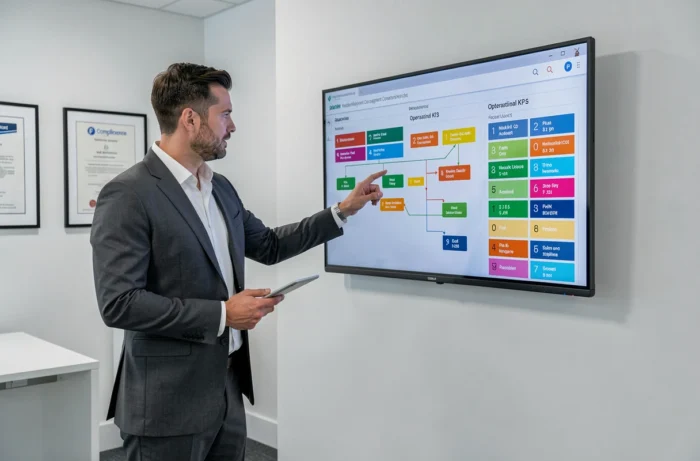
The term “health consulting” remains vague in the minds of many general practitioners and specialists. It is not an IT service nor a simple organizational advice. Professional health consulting operates at several levels simultaneously.
- Organizational audit of the practice: mapping administrative tasks, identifying processes that consume medical time without direct added value for the patient.
- Regulatory support: monitoring obligations related to the Ségur du numérique, health data protection standards, and the requirements of the Digital Health Agency.
- Change management of tools: selection of a referenced practice management software (LGC), coordination with the publisher, training of administrative and medical staff.
- Financial optimization: identifying public funding mechanisms (SONS, ARS aids) and securing files before deadlines.
Field feedback diverges on one point: some practices believe that an internal audit is sufficient, while others find that regulatory complexity exceeds their non-medical skills. The size of the practice, the number of practitioners, and the existing level of digitization largely determine the real need.
A service that varies according to the size of the structure
For a solo general practitioner, consulting focuses on software choice and compliance. For multi-professional health houses or centers grouping several specialists, coordination among practitioners becomes the main issue. Shared protocols, differentiated access to patient files, reporting to ARS and CPAM: these functions require configurations that few practitioners master without external help.
Patient data cybersecurity: an underestimated angle in medical practice management
Medical practices handle some of the most sensitive health data under GDPR. Cyberattacks targeting the healthcare sector have multiplied in recent years in France, affecting both hospitals and city structures.
A private medical practice is not immune to a patient data leak. The legal responsibility of the practitioner is engaged in case of a protection failure, which adds a layer of risk beyond mere technical inconvenience.
Practice management solutions must integrate certified HDS hosting (Health Data Host). However, the certification of the host does not exempt the practice from its own obligations: strong passwords, encryption of exchanges, regular backups, staff awareness.
A serious health consulting service includes a cybersecurity component in its diagnosis. This is not a luxury: it is a component of regulatory compliance that software alone does not guarantee.

Billing and teletransmission: the concrete gains of a rethought organization
Billing remains one of the most time-consuming administrative tasks for medical practices. Between teletransmission rejections, unpaid invoices to follow up on, and tariff updates, the time spent on billing directly reduces the number of possible consultations.
A referenced Ségur wave 2 management software automates part of these tasks: calculation of conventional rates, generation of electronic care sheets, payment tracking. Automation does not eliminate all human intervention, but it significantly reduces data entry errors and back-and-forth with CPAM.
What technology does not solve alone
Adopting software does not alone resolve billing issues. Practices that make the best use of these tools are those that have reviewed their processes beforehand: who bills, at what time of day, according to what verification procedure. The tool amplifies the existing organization; it does not replace it.
It is on this point that the intervention of a medical practice management consultant differs from a simple software deployment. The diagnosis focuses on the overall workflow, not just on technical functionalities.
The regulatory landscape of digital health is evolving rapidly, with binding deadlines and time-limited funding. For medical practices, waiting for the issue to become urgent often means losing access to funding mechanisms. Structuring the transition now, with or without external support, remains the most concrete decision to make.