
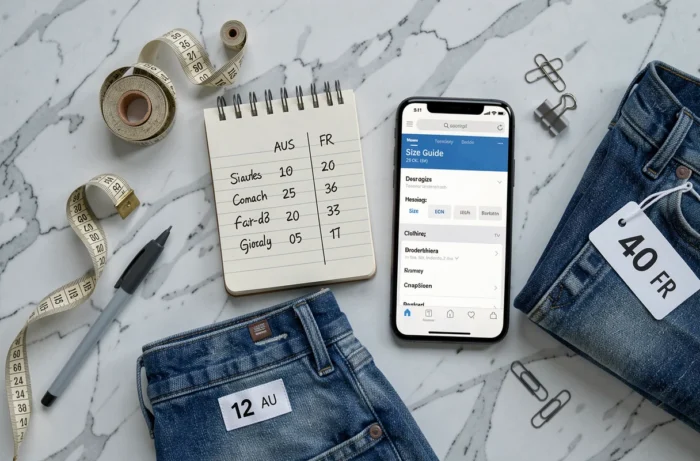
Australian sizes do not follow the same system as French sizes, and the confusion is not limited to a simple shift in numbers. Australia has abandoned its national standard for clothing sizes, leaving each brand free to define its own size charts. Converting an Australian size to a French size therefore requires more than just a generic chart: it is essential to understand what each number on the label actually represents.
Why converting Australian sizes to French sizes is not a simple shift
Most online guides present the conversion as an arithmetic operation: add a certain number to the Australian size to get the French equivalent. The reality is more complex.
Australia has removed its national standard for clothing sizes. This withdrawal, documented by the Consumers Federation of Australia, means that there is no longer an official reference guaranteeing that an AU 10 corresponds to specific measurements. Two Australian brands can label AU 10 clothing with measurements that differ by several centimeters.
In the same Australian wardrobe, a customer may wear classic AU sizes (6, 8, 10), letters (S, M, L), European numbers (36, 38, 40), or even series 1 to 4 for underwear. This coexistence of systems within a single country makes any universal size chart approximate. A detailed article like the Australia France size guide on 2moiselles Happy Lookeuses helps to better understand these subtleties before placing an order.

Women’s size matching: Australia, France, and measurements
For women’s clothing, the Australian size chart generally starts lower than the French chart. The often-cited principle is based on a gap of about thirty units between the two systems: an AU 8 roughly corresponds to a FR 36, an AU 10 to a FR 38, and an AU 12 to a FR 40.
This principle works when the brand actually uses the traditional AU scale. Australian brands like Bianca Spender or Joseph Ribkoff now publish conversion charts directly aligning AU/UK with FR/EU, including bust, waist, and hip measurements for each size. This recent convergence offers more reliable matches than old generic charts.
Measurements to take before ordering
A conversion chart remains indicative if you do not know your own measurements. Three reference points should be taken with a flexible measuring tape:
- Bust measurement: taken at the fullest part, without compressing, arms at the sides
- Waist measurement: at the natural waistline, without sucking in the stomach or tightening the tape
- Hip measurement: at the widest part of the hips, over the buttocks
These three measurements, compared to the targeted brand’s guide, provide a much more reliable result than a simple AU to FR conversion. The brand’s size guide always takes precedence over a generic chart.
Men’s sizes and shoe sizes: specific pitfalls
Men’s clothing follows a similar logic with a shift between the Australian and French charts, but the discrepancies vary depending on the type of clothing. For tops and jackets, the Australian size generally aligns with the British chart. An AU/UK M often corresponds to a FR 48 or 50, depending on the cut.
Pants present a particular case. Some Australian brands use size in inches (like in the United States), while others use local numbering. Checking the unit of measurement before any conversion avoids confusion between a 32 in inches and a 32 on a European scale.
Shoe sizes: another reference system
Australian shoe sizes follow the British system, not the American system. The difference with French sizes is significant. An AU/UK 7 women’s size is approximately equivalent to a FR 40, while an AU/UK 9 men’s size is roughly equivalent to a FR 43.
The additional difficulty comes from the fact that some Australian sites also display US sizes, which differ from AU/UK sizes by half a size to a full size depending on gender. Identifying which system is used on the product page is the first step before placing any order.
Check before buying: the reliable method for online shopping from France
Generic conversion charts provide a useful framework, but every online purchase from Australia requires verification on the brand’s website. Several points deserve systematic attention.
- Look for the size guide or size chart on the brand’s website, not on a third-party converter. Australian brands selling internationally increasingly offer a FR or EU column in their guide
- Compare your measurements in centimeters with those in the guide, not just the size number. An AU 12 from a fitted brand and an AU 12 from an oversized brand do not cover the same measurements
- Check the return and exchange policy before ordering. International shipping costs make exchanges expensive, and some brands exclude returns from abroad
- Consult customer reviews that mention sizing (“runs small”, “true to size”, “runs large”) to adjust your choice
Field reports vary on the reliability of standard conversion charts. Some buyers report a perfect match with the classic shift, while others note significant discrepancies depending on the brands. The absence of an official Australian standard explains these variations.
International shopping between Australia and France is becoming simpler as brands harmonize their online size charts. Taking your measurements once, keeping them handy, and systematically cross-referencing them with each brand’s guide remains the only method that truly protects against sizing errors.