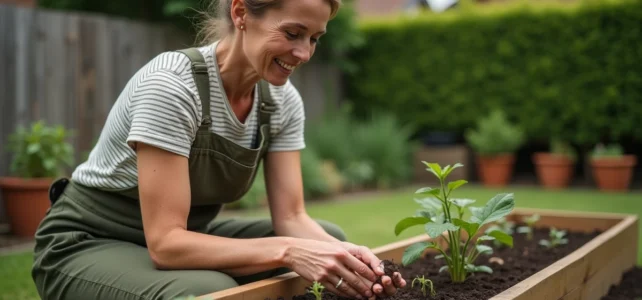
What measurable parameters distinguish a productive garden year-round from a green space that languishes between two seasons? The answer lies less in the repeated actions each month than in three often poorly calibrated variables: soil quality, the actual sowing calendar relative to the local climate, and water management over twelve months. An analysis of documented practices in 2025-2026 allows for concrete benchmarks for effective gardening, from vegetable gardens to flower beds.
Living soil and fertility: indicators that guide your cultivation choices
Most gardening guides start with planting. The problem is that planting in poorly characterized soil is like building on unknown foundations. A soil test before any new season (pH, organic matter content, texture) radically changes the results obtained in both vegetable and ornamental gardens.
Research conducted in the canton of Fribourg on reduced tillage shows that untilled soil retains its structure and biological life better. Specifically, limiting deep digging preserves the networks of mycorrhizal fungi that facilitate nutrient absorption by plants.
For those seeking additional resources on the fundamentals of gardening, the site https://www.infojardinage.com/ gathers practical sheets by type of crop and by season.
Compost and mulching: two levers to compare
| Criterion | Homemade compost | Organic mulching |
|---|---|---|
| Effect on fertility | Direct supply of nutrients and microorganisms | Slow degradation, gradual enrichment |
| Water retention | Improves deep soil retention capacity | Reduces surface evaporation |
| Work required | Regular turning of the pile, maturation over several months | Simple laying, seasonal renewal |
| Impact on weeds | Low (unless the compost contains seeds) | Partial suppression through coverage |
| Cost | Almost zero (kitchen and garden waste) | Variable depending on the material (straw, wood chips, dead leaves) |
The two approaches are not mutually exclusive. Combining compost in the fall and mulching in the spring covers both functions: nourishing the soil and then protecting its moisture during the hot months.
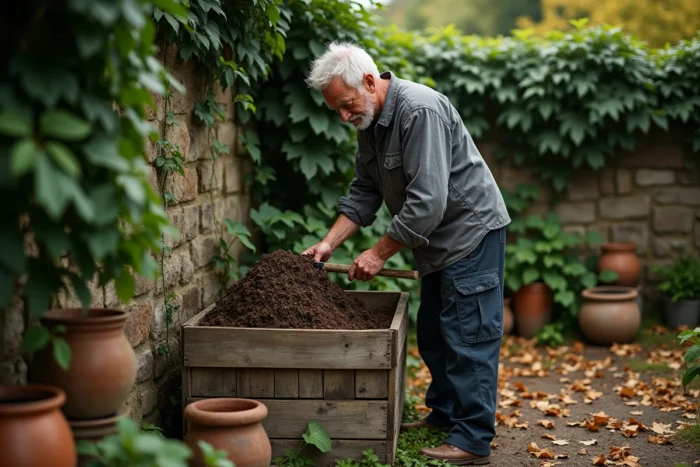
Sowing and planting calendar: stagger to harvest better
French garden centers observe a peak in attendance in May-June for sowing and planting. This collective reflex creates a problem: everyone plants at the same time, often too late for some crops, too early for others depending on the actual climate zone.
An effective sowing calendar relies on the date of the last local frosts, not on the month indicated on the seed packet. Between Lille and Montpellier, the gap can reach several weeks for the same vegetable.
Fall and winter sowing: the neglected vegetable garden
Cold-season sowing remains underutilized by the majority of amateur gardeners. Lamb’s lettuce, spinach, fava beans, garlic, and onions are planted between September and November depending on the regions. They occupy the soil during the low period and produce from the end of winter.
- Fava beans sown in October-November: harvest possible as early as April, even before the first tomato sowings
- Garlic planted in autumn: larger bulbs and better disease resistance than spring garlic
- Green manures (mustard, phacelia) sown after the last summer harvests: they cover bare soil, limit nutrient leaching from winter rains, and are mowed before spring plantings
This twelve-month rotation maintains permanent plant cover, aligning with the principles of living soil mentioned earlier.
Water management in the garden: adapting irrigation to climatic episodes
French summers are becoming hotter and drier. Water restrictions are multiplying, and poorly planned irrigation wastes resources without real benefits for plants. The issue is no longer to water more, but to water better.
Watering in the evening or early morning reduces evaporation. Drip irrigation, placed at the base of plants, consumes significantly less than overhead watering. However, thick mulching (several centimeters of organic matter) significantly decreases the frequency of necessary watering, even during heatwaves.
Rainwater harvesting: a simple calculation
The roof area of a house allows for the collection of a considerable volume of water over a year. Even a modest tank covers part of the watering needs of the vegetable garden during dry months. The return on investment depends on the installed volume and local rainfall, but in most cases, a rainwater tank pays for itself in a few seasons.
Biodiversity in the garden: why pollinators change the game
Studies conducted in Rennes and Montpellier document an interesting phenomenon: a network of micro-gardens, flowering balconies, and green roofs functions as a relay station network for pollinators in urban areas. Municipalities practicing differentiated management (areas of unmown grass for part of the year) observe a marked increase in the presence of pollinating insects.
For a private garden, this translates into concrete choices:
- Leaving a strip of unmown grass along a fence or under a tree, even over a few square meters
- Planting flowering plants with staggered blooming (crocuses in late winter, lavender in summer, asters in autumn) to ensure a continuous food resource for bees and butterflies
- Avoiding chemical treatments that decimate garden auxiliaries, including natural predators of aphids
Vilmorin has also evolved its range of flower seed mixes in 2026, integrating more species favorable to pollinators. This direction confirms that productive gardening and biodiversity are not contradictory goals.
The Zero Net Artificialization (ZAN) law, which aims to stop any net artificialization of soils by 2050, gives private gardens an additional role: water infiltration surface, cool island, ecological corridor. Every square meter of cultivated or simply vegetated land contributes to this goal, including in co-ownership, where a recent evolution of the legislative framework facilitates the official recognition of private gardens.
A tested soil, a calendar aligned with the local climate, water management adapted to increasing restrictions, and a few square meters left for pollinators: these four measurable and adjustable parameters determine the success of a garden over twelve months much more than the accumulation of seasonal actions.