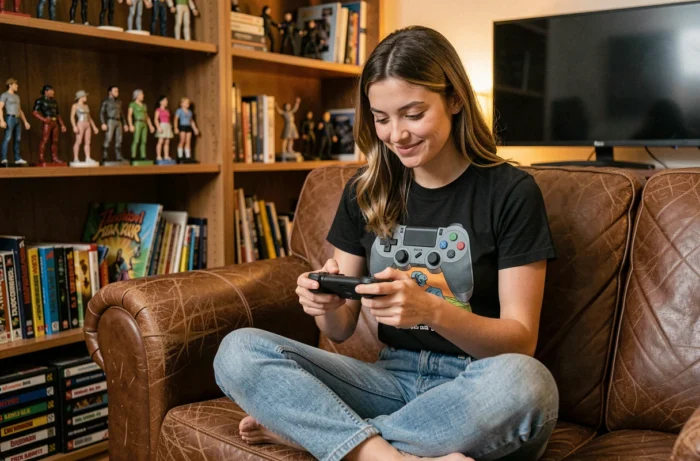
In France, women now represent 49% of video game players. This near-parity in usage contrasts with their position in the industry that produces these games, in the media that discuss them, and in the communities that animate them. Female geek culture is not just a matter of tastes or merchandise: it highlights structural gaps between practice and representation.
Video games and women: a gap between players and creators
The Senate’s information report (n° 854, 2025-2026), titled Video Games: From Game Boy to Girls in the Game, Equality Loading, presents a clear observation. While half of the audience plays, women only represent 20% of the workforce in the video game sector in France. The higher you go in the technical or decision-making hierarchy, the lower the proportion drops.
The Senate notes that women occupy only 7.7% of technical jobs and about 14% of management positions in this industry. This imbalance is not limited to French studios: an analysis by EDHEC covering 160 games released between 1988 and 2025 (representing 1.4 billion copies sold) concludes that less than 2% of the titles studied achieve true parity between female and male characters.
Women gamers are present. Characters and positions that resemble them are much less so. This gap fuels a cycle: without visible role models in creative professions, female vocations in the sector struggle to emerge.
Specialized media document these changes and offer content designed for a female geek audience. This approach can be found on geeketteinside.fr, which covers tech, pop culture, and gaming without confining female readers to a marketing segment.
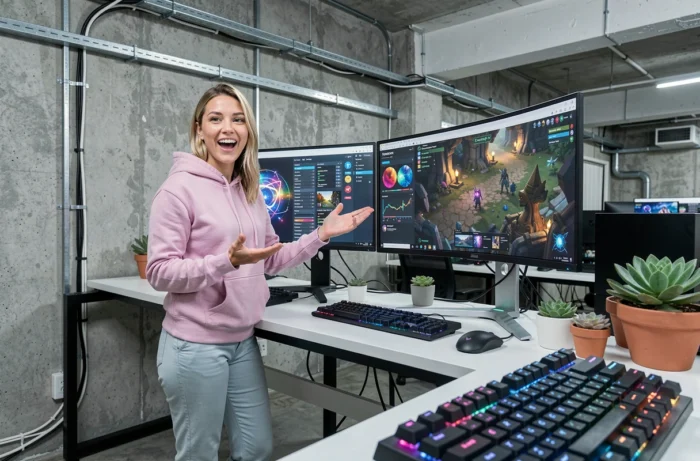
Representation in pop culture: stereotypes and signs of change
The issue goes beyond video games. In comics, cinema, and youth literature, female characters have long been relegated to secondary roles or visual archetypes (the famous “boob armors” of role-playing games, or the eternal damsel in distress).
Some recent signals deserve attention. Big-budget franchises are incorporating more complex female protagonists, from independent video games to streaming series. Francophone geek festivals, such as Bordeaux Geekfest and Angers Geekfest, dedicate entire conferences and publications to the subject, like the encyclopedic book M42 dedicated to female geek culture.
However, EDHEC notes a stagnation, even a regression, in the representation of women in certain segments: development studios, management positions, and professional e-sports competitions. Progress is therefore neither linear nor guaranteed.
Women and tech fields: why the orientation gap persists
The problem crystallizes well before entering the job market. Available data do not allow for a conclusion of rapid improvement: field feedback diverges on the effectiveness of awareness programs.
Several factors combine:
- Self-censorship as early as high school: girls are less likely to pursue math and computer science specialties despite comparable results.
- The lack of accessible role models: digital pioneers, like Ada Lovelace, are rarely highlighted in school curricula.
- A professional environment perceived as unwelcoming: the Senate report emphasizes that sexist behaviors in video game studios hinder the retention of female talent.
Initiatives do exist. Actors like France Travail or regional associations offer support pathways for women wishing to enter the sector, but the gap remains significant in pure digital fields.
High-tech tips: what uses are emerging among geekettes
Beyond sector numbers, practices are evolving. Mobile gaming and online gaming represent the segments where parity is most advanced. Podcasts and content channels hosted by female geeks are multiplying, covering topics ranging from hardware testing to series analysis.
On the connected objects side, European regulation is progressing. The strengthening of oversight on connected glasses in France reflects a framework under construction. These developments concern all users, but they also respond to long-expressed concerns from online female communities, particularly regarding privacy protection and digital harassment.
Here are some guidelines for navigating this universe:
- Prefer moderated communities and Discord servers with active anti-harassment policies.
- Test streaming platforms that highlight female content creators (Twitch, YouTube) through their dedicated programs.
- Follow specialized accounts that cover both tech and pop culture from an inclusive angle, to stay informed about new developments without marketing filters.
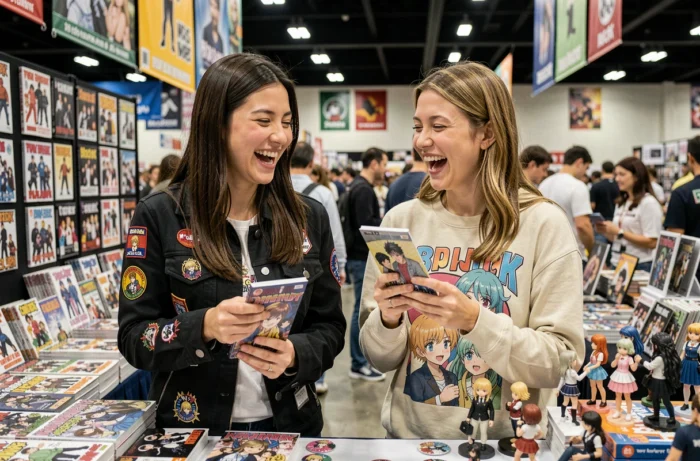
Female geek culture is not a sub-genre. It reflects a demographic reality (half of the audience) that is still waiting for its translation in studios, events, and content.
The data from the Senate and EDHEC show that usage parity is not enough to create representation parity. The movement exists, as do the barriers. What is most lacking is not players or readers, but the structures capable of keeping them in the ecosystem once they have entered it.


